On Saturday I visited the Warfare show in Reading for a couple of hours. This show is the final show of my year and represents an opportunity to make purchases to cover my Christmas break. Warfare always feels like an old fashioned show; there are a lot of competition games going on, the demo games are fine but not major eye-candy, the retailers are packed into a sports hall, and the B&B is large. I travelled by train this year, so did not have the usual car parking problems. The B&B was disappointing, there was not as much on offer this year and I did not make any buys. I bumped in to many wargaming friends which is always nice, and saw my mate, Graham, who was taking part in the FoW competition. The demo game which stood out for me was the attack on Foy, set during the WW2 Battle of the Bulge, using CoC rules. The winter setting and figures were beautiful!
The trade hall is the main attraction for me, and I quickly set about purchasing my 20mm USMC and Japanese WW2 forces I had planned for Bolt Action. The core of each force was battlepacks from Lancaster Games, supplemented by additional figures from Britannia Miniatures. I also stopped to look at other 20mm manufacturers; Sgt's Mess and SHQ, and made some extra purchases from them. Once these acquisitions were safely in my bag, I toured the traders making small purchases here and there! A few MDF bases, a pot or two of paint, a pack of dice and some markers, another Western building etc I dithered about getting the 'Pike & Shotte' rules from Warlord, but resisted because I'm undecided about the whole Black Powder system - it all looks very pretty but it doesn't grab me. There appears to be a revival of Ancients rules at the moment, and certainly the demo games featured a few new products, of which To The Strongest seem to be popular. I think I will resist and wait for time to sort the wheat from the chaff. I currently happy using Impetus and Sword & Spear.
After a couple of hours I had reached the point where I needed to leave. If I stay beyond this moment I find from past experience that I make foolish buys. So, another year of shows has passed, roll on 2017!
Monday, 21 November 2016

Monday, 14 November 2016
Boardgame session: 12Nov2016
Val and Chris came over and we decided to give ‘Galaxy
Trucker’ its first outing (I bought this second hand at Salute in September). I
was not sure that this would be a game Elaine would enjoy; the whole SciFi
scene is generally not her cup of tea. After quickly running through the rules,
especially on constructing a spaceship, we set off. The building phase seemed
more manic than I had anticipated, the parts you want just don’t seem to come
up, keeping track of parts discarded by others is more difficult than expected,
and areas of construction become blocked off. Once the first player completes
and the final timer is turned, the action really hots up. Surprisingly we all
were good at building ‘legal’ vessels, and only rarely did they fall apart on
examination. The convoy section of each round does not require much in the way
of decision making – things (mainly bad) just happen. There was considerable
humour as you watch other players spaceships fall apart. In the first round Val’s
ship was totally KO’d, and Elaine’s ship went the same way in the second round.
Both Chris and I survived the whole game, but Chris was clearly the winner. Val
had a good final voyage and took second place, whilst I came third. Elaine’s
chances were scuppered by her failure in the middle round.
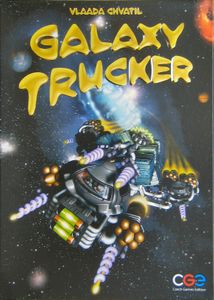
The post game discussion clearly showed that we all enjoyed
the game, and Chris revealed that he had played the online game previously,
which I’m sure contributed to his success. The focus of the game is the ship
construction phase and we all enjoyed the pressure applied by the turning of
the timer. Interestingly none of us looked at the upcoming adventure cards; I
certainly planned to but the drive to add to your construction wiped this
intention from my thoughts. The voyage phase is mainly chance and players need
to be relaxed about the outcomes. If your ship falls apart, all you can do is
laugh with the others! You never seem to have enough of certain parts, I never
seemed to get enough engines and I think coming in first during a convoy is
important for winning. Anyway, I feel that Galaxy Trucker will get many future
outings, and I’m glad I picked it up cheap!
Thursday, 10 November 2016
Off the Painting Table (Nov 2016)
As discussed previously I am considering buying a matched
pair of 20mm USMC/Japanese forces for Bolt Action. Obviously amphibious
landings are a significant factor in this theatre. I happened to visit
Hobbycraft (looking for storage boxes) and spotted the old Airfix kits. I have
not put an Airfix kit together for over 30 years, and all my childhood memories
came flooding back! Before I knew it I had purchased a DUWK, Buffalo LVT and a
Churchill tank. I spent a happy few days assembling and painting the models
whilst wallowing in nostalgia. Blimey, they certainly liked to model suspension
systems in great detail – so many small, fiddly bogeys!

Now I need the figures, I did consider using Airfix again,
but quickly reject this idea. I think I will base my forces on some Battlepacks
from Lancashire Games (nice and cheap) which I plan to buy at Warfare in a
couple of weeks, supplemented by extras from Brittania Miniatures. Does anyone
know whether these figures are compatible, and have suggestions about other
manufacturers?
Monday, 31 October 2016
Boardgame session: 29Oct2016
We visited my sister for the w/e, and I received my belated
birthday prezzie – the boardgame ‘Sheriff of Nottingham’. Elaine and I had
previously played this at this years’ Games Expo event and really enjoyed it.
So, I immediately punched out the counters and set up a game (shuffling the
~150 cards is quite a task!).
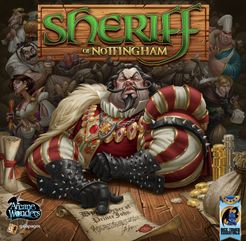 The game rules are simple and all players
quickly got into the swing of things – a good combination of honesty and lying
by all. This is very much a game of bluff, with a nice mix of bribery added. I
think all players could improve their bribes, we tended to stick to simple cash
offers rather than use goods or promises. Somehow no-one ever seems to believe
Elaine, so her bag was nearly always searched! I don’t think lying comes
naturally to her, and I feel she could exploit this trait to force the sheriff
to pay out for legal shipments. As I originally surmised when I first
encountered this game; Erin would be a good player. When the final points were
tallied, Erin won with a 20 point lead over myself. Gill was third and Elaine
trailed, but not by much. Having a lead in chickens, together with a few high
value smuggled goods, seemed to be the key to Erin’s success. All players
enjoyed the game and predicted that it would get many more plays.
The game rules are simple and all players
quickly got into the swing of things – a good combination of honesty and lying
by all. This is very much a game of bluff, with a nice mix of bribery added. I
think all players could improve their bribes, we tended to stick to simple cash
offers rather than use goods or promises. Somehow no-one ever seems to believe
Elaine, so her bag was nearly always searched! I don’t think lying comes
naturally to her, and I feel she could exploit this trait to force the sheriff
to pay out for legal shipments. As I originally surmised when I first
encountered this game; Erin would be a good player. When the final points were
tallied, Erin won with a 20 point lead over myself. Gill was third and Elaine
trailed, but not by much. Having a lead in chickens, together with a few high
value smuggled goods, seemed to be the key to Erin’s success. All players
enjoyed the game and predicted that it would get many more plays.Friday, 21 October 2016
Review of Bolt Action version 2 Rules
I finally decided to purchase a copy of the latest Bolt
Action version 2 rules by Alessio Cavatore & Rick Priestley (Warlord
Games/Osprey, 2016) a few weeks ago. I should stress that I have no significant
previous experience of the first version, and therefore cannot comment about
changes made. I have also never played 40K, so cannot say whether Bolt Action
are similar or not. Since they arrived I have played approximately a dozen solo
1,000 point games using a diverse range of army lists, all late war European
games. Some games involved standard infantry-heavy forces, whereas others had
various tank add-ons, or infantry in APC’s etc. Most games used regular units
but I did try inexperienced units, and veteran units. All games used the
supplied scenarios and I have now played most of the 12 scenarios listed.
The publication is a beautifully illustrated, A5 sized,
hardback. The use of Osprey as the publisher means that many of their excellent
pictures are included, and these are augmented by a scattering of photos
showing various nicely painted miniatures. There is surprisingly little
‘fluff’, which is personal bug-bear of mine, and a brief timeline of WW2 is
solely there as an intro. The rules revolve around a re-enforced infantry
platoon structure with tanks/armour playing an ancillary role. This is exactly
the size of 20/28mm game I wish to play, which is great. As a consequence the
rules are infantry focussed, with the section on vehicles, artillery/air
supports and urban fighting added after the main rule structure has been
explained. Next there are 12 different scenarios, all briefly explained and
providing alternatives to the simple meeting engagement. Finally there are
basic army lists for the 5 major late war protagonists: Germany, USA, UK, USSR
and Japan. These lists are not exhaustive but do provide enough information to
allow representative forces to be generated. Bolt Action do sell additional
books on each army and/or theatre giving greater detail and expansion
opportunities, but I’m personally not sure I will go down this potential
financial sink-hole! I hope to peruse friends copies to garner the small
amounts of additional information I may require. It is interesting that the
lists in the main rule book do miss a few ‘obvious’ entries: no German
Panzerschreck teams, no US Marine flamethrowers, no British 2” mortars, no
Russian tank-riders. Maybe this is to encourage players to buy the supplements?
The rules themselves are well written and have numerous
clear illustrations to highlight the mechanics. When I needed to check an issue
in a game I was able to quickly find the relevant section in the book. All the
rules use the standard 6-sided dice (no fancy dice required).
The assignment of orders by the random drawing of custom
order dice from a bag works well (the authors do discuss cheaper alternatives
to these dice), and the range of orders available are consistent with those
found in many other rules. The random nature of the turn order allows for
uncertainty, reflecting the ‘fog of war’, and makes the rules very suitable for
solo play. Officers, especially higher ranks, can be useful for co-ordinated
moves, particularly early in the game, by drawing additional dice. The
non-active player can choose to order a targeted unit ‘Down’ to significantly
reduce the effects of incoming fire, but this burns a valuable turn for that
unit.
Movement is simple, both for infantry and vehicles; either
an ‘Advance’, which allows firing or crossing difficult terrain, or the double
speed ‘Run’ order. Bolt Action scenario games tend to only last 6-8 turns, so
there is little time to carefully manoeuvre or set–up an attack, instead forces
tend to get in fast. There is no subtlety in the infantry tactics; you cannot
use your MG34 to provide covering fire as the riflemen of the same squad dash
across the street, the whole section moves or not. Combat can occur in the very
first turn of a game!
Firing is also simple with a basic 3+ to hit (plus a few
modifiers), followed by a quick ‘to kill’ dice roll (adjusted by the target
quality). Bolt Action games are bloody, but hits also inflict ‘Pins’ even if no
kills result, which can be as significant as actual kills. Units with multiple
‘Pins’ can just sit around with their heads down, and often require rallying
(which is surprisingly easy but does negate a valuable turn). Additionally,
weakened units can suddenly evaporate leaving alarming holes in your lines at
the most inopportune times! Anti-tank fire is simple, requiring a penetration
dice roll and damage effect if successful. Bolt Action is not a set of rules
for ‘tankie’ gamers; there are only 4 levels of gun and 4 levels of armour. So,
if your thing revolves around variation between a PzKfw IV model F2 compared to
the H model, then these are not the rules for you! I soon learnt that the
German player should take plenty of cheap Panzerfausts. Firing HE rounds again
uses similar mechanisms and employs circular templates of different diameters
to determine the number of potential hits. From previous gaming experience this
can cause issues in opposed games; is the figure just in, or out, of the blast
zone? The irritating situation I commonly found using the rules, concerned
Snipers. They seemed to be far too deadly, picking of key team members at will,
and the best counter was to use your own sniper to take out the opposing
sniper.
In Bolt Action close combat is more frequent compared to
other rules I have played, and it is devastating and decisive. The loser is
KO’d and removed from the game. The defender’s best defence is to employ an ‘Ambush’
order to fire as the attacker comes in. But the question is whether to maintain
this order at the turn end and not fire at all (because you were not assaulted),
or try to convert it into a ‘Fire’ order and cause some damage to enemy units?
You can find opposing units both quietly sitting waiting for the other to
blink, resulting in an uneasy truce!
Off-table artillery strikes and close air support rules are
interesting because you are not certain about what will arrive, or when. In addition
to damage inflicted, they can cause widespread disruption by placing multiple
‘Pins’ on units close to the target zone. The British ‘free’ FAO team is a
powerful bonus, and the US FAC team with a second strike capability can also be
deadly. I’m not sure the Russian Katyusha elements should be an on-table
support option. I also liked random nature of air strikes and the panic they
cause to both sides, plus the possibility of friendly A/A fire occurring.
So, what do I think of Bolt Action version 2? How do they
compare with my other WW2 favourite, Chain of Command? Bolt Action gives a very
fast, action packed game that is fun to play. The simplicity of the rules means
there is little referring back to the main book and QRS covers most situations
(in fact, most actions don’t even require the QRS). They work very well for
solo play, and I look forward to playing opposed games in the near future. I
would summarise by saying Bolt Action gives a good ww2-GAME, compared to Chain of Command which gives a good WW2-game. I think I will
continue to use Chain of Command for opposed games against experienced players,
but Bolt Action will now be used for my solo play and those quick, pick-up club
games against non-WW2 gamers. I think it interesting that both sets of rules
focus on the same command level i.e. the re-enforced infantry platoon. If I
wanted to play using a higher command level with more troops, especially tanks,
I would probably opt to use the Battlegroup Kursk/Overlord rules.
Readers thoughts, comments, criticisms, disagreements are
always welcome. Finally, Bolt Action has encouraged me to play more WW2 games
and I’m now seriously considering buying a matching pair of Japanese and US
Marine forces.
Tuesday, 18 October 2016
AAR; ACW (Longstreet rules) 16 Oct 2016
We managed to fit in another Longstreet ACW battle (late 1864)
of the mini-campaign. This time we played the ‘Railway Embankment’ scenario,
and I again won the scouting phase and choose to be the defender. Additional
terrain was added, with Ian placing some woods just forward of my deployment
area, whilst I placed areas of swamp across his lines of approach. Ian placed
the objective marker as far to my right as possible. I chose to leave my new 10-base
US Coloured unit (E/R) as my off-table reserve (arriving on turn 6). I forgot my
camera (again!), so no photo’s. Ian did take a couple on his phone and I may
add these to this report at a later time.
In the opening turns I advanced my battleline forward to
give me some breathing room. The central wooded area Ian placed actually helped
me because I deployed my 2 sharpshooter units in them. It soon became clear
that Ian’s attack would fall upon my centre, and especially on my right flank.
I deployed a battery of Napoleons (37th Pa) and a unit of men armed
with repeaters (8th Maine) on the gentle hill to block this. I was
also able to redeploy my other 4-base Coloured unit (E/R) and a battery of
light rifles to act as a reserve, and cover the objective.
For some reason, Ian did not press his attack in the centre
and seemed to be content to remain just outside 6” engagement range. His main
focus was on my right flank, but again he initially concentrated on fire combat
rather than coming straight in. This gave me time to bring on my strong reserve
formation and at this point I was confident of victory. Ian finally KO’d my
artillery battery and charged the 8th Maine, who were totally destroyed,
but of course his troops were now vulnerable to my counter-attack. The large
and eager US Coloured units duly obliged and were successful. The Union was now
very much in the ascendency and began an advance in all areas. The Rebel loses
mounted as they were forced back and finally victory was achieved.
In the Campaign phase, I rolled well, lost few bases and
none of my units lost any Elan. I did not successfully roll for promotion, but
achieved the coveted 4 Eagle rank by drawing a promotion Campaign card. My
revised force for the 9th and final battle of the campaign is shown
below:
|
Commander
|
Personality
|
Rank
|
EP’s
|
||||
|
“Art” Rooney
|
Indian Wars Veteran
(Scout: 2D6 & keep higher)
|
4 Eagles (2/64)
|
30
|
||||
|
Unit
|
Type
|
Elan
|
Exp.
|
Strength
|
Notes
|
||
|
37th (Prov) Pa Infantry
|
INF
|
Season
|
Veteran
|
6
|
|
||
|
13th\14th Pa (Prov) Inf.
|
INF
|
Season
|
Veteran
|
4
|
Sharpshooters (5,6 Skirm Fire)
|
||
|
16th\45th Ohio (Prov)
Inf.
|
INF
|
Caut.
|
Veteran
|
4
|
Sharpshooters (5,6 Skirm Fire)
|
||
|
26th NJ Artillery
|
ART
|
-
|
-
|
3
|
3x Lt Rifle
|
||
|
29th NJ Artillery
|
ART
|
-
|
-
|
3
|
2x Lt Rifle, 1x Hvy Rifle
|
||
|
7th US (Coloured) Inf.
|
INF
|
Eager
|
Recruit
|
4
|
|
||
|
8th Maine
|
INF
|
Season
|
Veteran
|
4
|
Repeaters
|
||
|
10th Vermont
|
INF
|
Season
|
Veteran
|
4
|
|
||
|
11th US (Coloured) Inf.
|
INF
|
Eager
|
Recruit
|
9
|
Sharpshooters (5,6 Skirm Fire)
|
||
|
1st NH Artillery NEW
|
ART
|
-
|
-
|
2
|
2x Lt Rifle
|
||
|
3rd NH Infantry NEW
|
INF
|
Season
|
Recruit
|
7
|
|
||
|
|
|
|
|
50 bases
|
|
||
|
Sabotage: enemy removes an extra 4 cards when first re-shuffles.
|
|||||||
Notes: The units are listed in order of campaign appearance.
The Pa units are from my original force. The 9th Pa Artillery (the
only original unit left) was destroyed.
At the end of this game I have amassed an unassailable EP points
lead (with 6 wins, 1 draw, 1 loss). In all our games, apart from the draw, the
attacker has lost. Because of my Indian Wars characteristic, Ian’s Rebels have
generally been forced to attack. He is understandably beginning to get a bit ‘peeved’
about this, so for the final game I have agreed to take on the role of attacker.
We will be playing the ‘Walled Farm’ scenario, which leaves the ‘River Crossing’
scenario as the only one we have not tried out. This is some relief to me
because I think the ‘River Crossing’ is heavily weighted in favour of the
defender!
Thursday, 13 October 2016
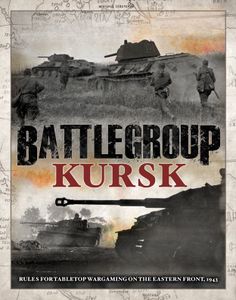
Review of Battlegroup Kursk rules
In an earlier blog post about whether to get the new Bolt
Action WW2 rules, I mentioned some other rules I had tried, and I considered
revisiting Chain of Command (CoC). When I went to my rules shelf I noticed a
rules bundle I had purchased at a B&B stall (I can’t remember where or
when) and I had never untied, or looked at them, once I had got home. These
were the hardback books Battlegroup Kursk (BGK), the Battlegroup Overlord
supplement and an A5 softback version of the rules (all together costing me
only £20 compared to a RRP of £70!). So, rather than play CoC again, I decided
to give BGK a go. I have managed to play a few solo games all using Eastern
front 20mm forces on a 6’x4’ table and 250 points (i.e. Squad level game).
The ‘Orders’ section of rules is straightforward; all the standard,
obvious options are available and include reactive orders, allowing covering
fire etc. The reactive movement (rather than the reactive fire) order is a bit
strange, and I never used this in my games. The turn order is IGO-UGO and
number of orders available to a player results from a single D6 roll plus the
number of officers in the force, which can give widely fluctuating results.
Larger games use multiple D6’s and give a more standard range of results. Some
things were not clear: German infantry sections have 2 teams (rifle and LMG)
and I was not sure whether this needed a single order (in which case, why have
separate teams listed), or individual orders (in which case, the German player
will struggle with the number of orders required)? Reading the Overlord
supplement, I found a rule for separating Bren teams from their sections in the
British listing, and I decided to use this for the German sections/teams in my
games (I’m still not sure if this is correct). I also was not clear about
man-portable heavy weapon teams (HMG, mortars etc.), because there did not
appear a requirement to set them up; could they simply move and fire like
normal infantry teams, or should they be considered as Very Light weapons teams
and need an ‘unlimber’ phase before firing?
The ‘Movement’ section is again nice and simple, but maybe
too simple? There is no deduction for infantry movement in rough/difficult
terrain. OK I can live with this, but I instinctively feel that marshes, woods,
hedgerows etc. would have an impact. What do you class man-portable heavy
weapons as? I think lugging a heavy base-plate for a mortar would significantly
slow you down. Tracked armoured vehicles can weave about with no apparent deduction;
I had a T-34 move down a road in a village, take a sharp 90 degree turn, then make
another 90 degree turn around the side of a house, and then another sharp turn
to face the enemy, all with no speed reduction.
The ‘Direct Fire’ mechanisms are again streamlined, all
basically following the same procedure: observation, hit, save/penetration. I
quite liked the fact you may not necessarily see the target and therefore not
fire; and also liked the differentiation between firing for effect and
pinning/covering fire. Pinning is pretty much as valuable as killing targets,
due to morale effects discussed later. I had no major quibbles about weapon
ratings etc., except possibly the German MG34/42 is over-rated? A rule that I
used frequently was when a squad was trying to close assault; if multiple casualties
are inflicted, you can instead take a single loss, retreat back to cover and
become pinned. The vehicle listing seems to indicate that players should record
the number of rounds fired. Really? I ignored this in my games – Life is too
short for such nonsense!
The ‘Indirect Fire’ section follows a similar process but
does raise some issues. I liked the ‘Communications’ aspect for calling higher
command support, but this does burn a players order count. The accuracy dice
roll again seems a bit random, and you can cancel the fire order if the ranging
round falls short. There is no ability to ‘walk-in’ the artillery in subsequent
turns, and the danger zone is standardised and not related to the calibre and
number of weapons firing. The biggest omission is the lack of smoke rules,
which is very strange indeed!
The ‘Morale’ section can be split into two. At a unit level,
a casualty or non-penetrating hit results in a simple D6 dice roll, Veteran/Elite
troops can re-roll, but this seemed to me to be too simplistic. Troops that are
already ‘Pinned’ and fail, rout off. If a player rolls a straight 6, then the
unit has a chance to take an immediate counter-action. At the battlegroup
level, each force has a numeric strength and morale effects result in the
random drawing of ‘Chits’ that reduce this value. I really like the uncertainty
this mechanism introduces, particularly because it can result in occasional
side effects e.g. mine strike, air strike etc. Reduction of battlegroup morale
to zero results in defeat. Strangely, rallying unit/units from Pinning requires
the drawing of a chit to rally D6 units. It would seem that waiting for the
number of Pinned units to rise before rallying would be sensible, but this is
often not practical. Units that tend to be pinned are those at the focal point
of your plans, so you cannot wait to get them active again, and therefore you
have to rally even if only a single unit needs such treatment. I have found
games to be frequently lost simply by the effects of pinning opposing units,
and obliging an opponent to rally. Maybe my game play and/or tactics are at
fault, and I would be interested to hear what other gamers think?
Before I discuss the non-rules aspects of the BGK
publications, I will comment about the type of game they give. I like the speed
of play, the mechanisms are clean and simple, and the use of chits to determine
victory is good. The order system is fine but rather random when using ‘Squad’
level games. Combat is clear and does not require constant double checking in
the main rules. The main weakness lie in the unit morale system (too simple)
and rallying. The lack of smoke rules is bizarre! Overall, I cannot see BGK
becoming my go-to WW2 rules. I will stick to CoC, which I think gives a better
game, and I also still intend to try the new version of Bolt Action.
The A5 paperback rules are excellent (only £10).
Regarding the hardback publications (£25-30 each), I would be very disappointed
if I had purchased them at the normal price. Why do authors think they have to
provide pages and pages of potted history in such publications? If a reader
wants historical background then there are a wealth of sources, online or published,
that can be easily accessed and provides
for all needs, in greater detail and accuracy than provided in these rule
publications. They then add in a simple painting guide as well. Do they think a
person buys BGK as their sole source on a period, especially ones as well
documented as Kursk or Overlord? I’m sorry to say that I find this ‘fluff’
annoying, especially because it’s inclusion bulks up the book and results in increased
cost for little benefit. The majority of both hardback books centre on army
lists. I generally enjoy a good army list. I find they inspire me to
investigate/get new units, and I like the way they constrain players to field
forces that feature the common elements used historically. There are poor army
lists out there, which some players can exploit to generate ‘super’ armies but,
on the whole, I like an army list. The lists provided in Battle Group
Kursk/Overlord are bad! Not because they are inaccurate, unhistorical, or
unbalanced, but because they are extremely repetitious and tedious. For example
BGK has only 4 lists: German Panzer & Infantry, Russian Tank &
Infantry. This is fine, but each list repeats the information in the previous
list. They share the same elements on the whole; a German infantry
platoon/squad is the same in both German listings, as are the tank units,
support units, recce units etc. etc. I’m sure there must be a few variations
between lists, but 90%+ of each list is repeated information. The format of the
army lists is again poor; each list takes a dozen sides of A4, when a better format
could easily reduce this to a couple of pages! With a bit of thought and
editing the authors could reduce the entire rules to the A5 rules booklet and separate,
smaller, slimmer, A5 army listings. Even better would be to publish the army
lists online as free pdf files! Such a decision would make BGK an attractive
purchase, but in the present form I would not recommend these rules to another
gamer! What is even more astounding is the authors are producing further
campaign dedicated hardback books! Rather than finish on a negative note, I do
like the inclusion of minor, often neglected, support elements e.g. combat
medics, signallers, repair mechanics etc.
Subscribe to:
Posts (Atom)