Showing posts with label Napoleonic. Show all posts

Monday, 16 March 2020

AAR; Napoleonic (Sharp Practice), 15Mar2020


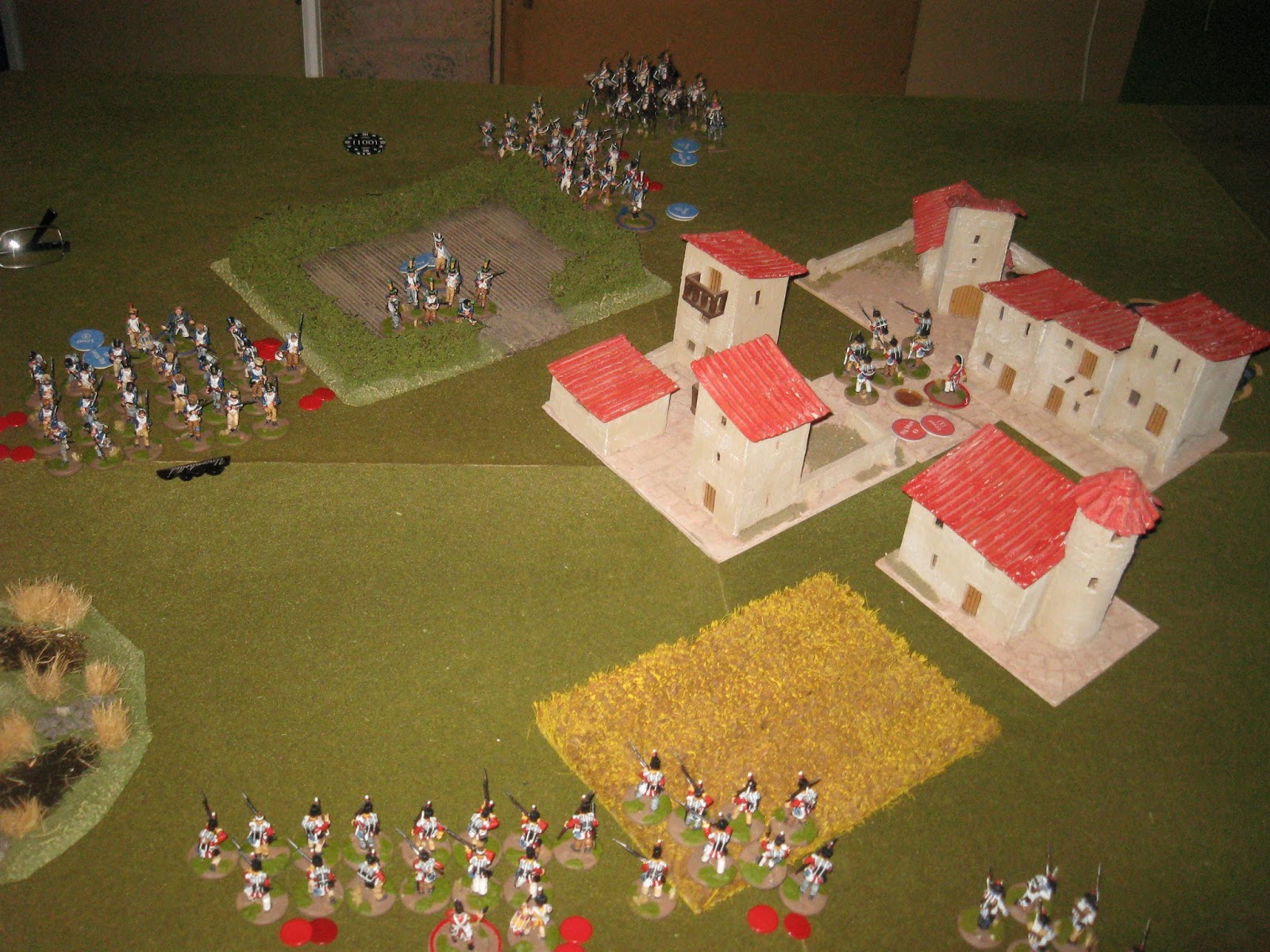
My Napoleonic rules odyssey continues, this time using Sharp Practice. I played used my Peninsular French against Ian using Spanish. A simple encounter game fighting over a small village with 55 points aside. In the opening moves Ian deployed and moved 2 groups of guerrillas in to woods on his left flank, whilst advancing with a formation of 2 groups of line troops between the woods and village, and a 3 group formation of line troops in column moved down the village main road. I opposed his main column with a group of voltigeur skirmishers, and on the other flank another group of voltigeur skirmishers held off his guerrillas. Between these forces I had a line formation of 3 groups of fusileurs, and a group of mounted dragoons were to move around the Spanish left flank.


I have noticed a peculiar phenomenon when playing Sharp Practice where the opening movement dice always roll low numbers, and the same happened in this game; my dragoons seemed to be cantering through quicklime and Ian’s columns were equally slow. I soon found out that irregular guerrillas in cover are not easy to shift, and in no time my voltigeurs were running for cover (in fact they never returned to the action). My other voltigeurs were happily taking pot-shots against the slow Spanish column, and my fusileurs got a couple of effective volleys at the other Spanish line formation. Suddenly the Spanish C-in-C motivated the column moving through the village to ‘step out’ and rolled high dice, so they plunged into fisticuffs with my voltigeurs who thought they were safe. The voltigeurs were wiped out but they did manage to wound the Spanish C-in-C, rendering him unconscious. Next turn he recovers, leaps back into the saddle and leads his men in a charge on the end group of my fusileur line! Luckily I hold and the round of fisticuffs is a draw, but the Spanish are now at 50% strength and the C-in-C gets killed. The resulting second round of fisticuffs was very one-sided, the Spanish are thrown back in to the village street and mill about without any leadership. My fusileur line formation is fragmented, but could be recovered. This was very much the turning point of the game, if the heroic Spanish leader had survived then victory could have been achieved. The loss of the Spanish leader effectively ended their aggressive moves and, finally, my dragoons were in a position to charge the recoiling Spanish. This they did and quickly destroyed any opposition, tipping the game and reducing the Spanish force morale to zero. So, a French victory!


A fun game that neatly fitted into an afternoon club meeting. The randomised leader activation mechanism works very well and introduces the right amount of uncertainty. The game turned on the performance of the heroic Spanish general; if he had survived then a glorious Spanish victory could have been achieved. I also learned that once irregular guerrilla skirmishers are established in cover, they are a very tough nut to crack. Cavalry can be devastating if they can get into a position to charge before they take casualties from firing.

Tuesday, 18 February 2020

AAR; Napoleonic (Lasalle); 16Feb2020


This was my first game of 2020, and I have not played an opposed game since mid-November. I have resolved this year to get some of my underused figures out of their boxes and on to the table. Therefore for this game I would use some of my extensive Napoleonic forces which comprise 25mm Minifigs from the mid-1970’s. I also wanted to try the Lasalle rules, with some new house rules I’ve worked on. These house rules cover terrain selection (similar to those found in Sword & Spear), plus a ‘recoil’ mechanism where disruptions are caused by enemy fire may force a retrograde movement (basically a Discipline test). The need for the ‘recoil’ rules were to allow for the possibility for defensive fire to halt attacking units, preventing contact. I hope this will make artillery less vulnerable to frontal attack, and reduce the certainty when attacking lines with multiple columns.
French turning the Russian left flank


We used forces from 1812. Ian was attacking with a French Infantry Division with an organic Light Cavalry Brigade. I was Russian, defending with an Infantry Division and a reserve Dragoon Brigade. Terrain selection resulted in a fairly open battlefield with an area of rough ground in front of my centre sector. I deployed first in a compact central position, with artillery on either side of the rough ground. Ian’s deployment was heavily weighed on his right flank, with a small covering force on the other half of the table. It was clear that my Russian left flank would be under pressure, but I was confident I could transfer sufficient units to hold on. This exactly what happened, but Ian moved faster and in a more determined manner than I had expected. Although I did move covering units, they were not able to deploy in an organised defensive line. More significantly, Ian’s rapid advance effectively denied me of a major part of my baseline on which I could deploy my reinforcements when they arrived. The gallant Russians on the left were ground down, whilst the Russian cavalry had to make a wide sweep around the right, only to run into massed French artillery protected by squares and cavalry! The highlight of the game must have been when one of my Russian squares was attacked by two French columns and a Chasseur unit; I rolled all hits whilst Ian rolled poorly, resulting in a French recoil! The square did not survive long though.
Russian dragoons swinging around the right, whilst the left collapses


The Russian break-point was reached on turn 13, but we held on until turn 18 when the Russian morale collapsed (a couple of turns more and I might have got a draw). Ian fully deserved the win. As for my house rules: The terrain selection worked but might need a little adjustment. The recoil rule worked well; simple to use, utilised an already established game mechanism, made attacking columns less predictable, allowed artillery a better option to hold and fire rather than just retiring. We both enjoyed the game which moved along at a rapid pace. It was interesting that my old Minifigs generated memories from other gamers at the club. I plan to have another game soon and try a different rule set; General d’Armee by David Brown.

Thursday, 12 December 2019

Impressions of Lasalle Napoleonic rules by Sam Mustafa


A few posts ago I mentioned that I had completed an inventory of my figures/armies, and that it was my intention to get some of the lesser used figures on the table. In the run up to Christmas my diary, and that of opponents, tends to get full and as a consequence the opportunities for competitive games dries up. I therefore turn to solo gaming and trials of different rule sets.

My large collection of 25mm Minifig Napoleonic armies are some of the oldest I possessing dating back to the mid-1970’s! The sculpts are poor by modern standards, but I find the old school style attractive. I have never considered the need to update any of the armies and the larger 28mm figures do not mix well. These armies have seen considerable action over their lifetime but have not come out of their boxes in recent years. I decided to rectify this and re-visit a set of rules I enjoyed when they were first released; ‘Lasalle’ by Sam Mustafa.

I have played four games covering all four theatres of operations (Conquest, Empire, Liberation and Peninsular) using French versus Austrian, Russian, Prussian and British forces. Each game revolved around the basic ‘Line’ Division, plus one additional brigade as outlined in the force selection part of the rules. I was pleasantly surprised how smoothly the games flowed, and appreciated how the game end victory conditions worked. The key rules design feature is a simple re-ordering of the standard player turn; instead of the normal move/fire/melee sequence, Lasalle changes this to fire(react)/melee/move. This basic change, at a stroke, removes all those ‘what if’ situations and out of sequence reactions found in almost all other rules. It introduces clarity and order, makes players choices clear, and allows greatly improved structure and order in the rule writing. The QRS is sufficient for most of the game, but when a point needs to be looked up, it can be quickly found in the relevant section of the rule book. Sam Mustafa’s writing is concise and thoughtfully illustrated with examples where needed, and the rules are beautifully produced. I used the advanced/optional rules because they are not complex and do add to the experience.

I think Lasalle represents one of the best sets of rules (of any period) that I own. They give a great game experience, and are an exemplar of how a set of rules should be written and published. They are not perfect, no rules are! I feel the terrain selection rules do not work well, the set up choices are limited and too often the defender will place a long stone wall across his frontline. This problem is easily rectified by substituting whatever terrain method a player prefers. I also feel it is too easy to charge artillery head on; the gunners really have no choice but to retire out of harms’ way rather than delivering a devastating blast of canister and stopping the attack in its tracks. I have a few minor ‘house’ rules I will introduce to my games, none of which drastically alter the nature of the game. I can see more Napoleonic games using Lasalle in the near future.

Wednesday, 5 September 2018

Off the Painting Table (Sept 2018)


I have long enjoyed playing Napoleonic skirmish games using the excellent Sharpe Practice rules by TFL. I have reasonable forces for the Peninsular campaign but lack any Spanish Guerrilla figures. I finally obtained a bag of 12 from Eagle Figures whilst at the Attack show in July.


The sculpts are slim and simple. There are 3 unique characters (a priest, a woman and a gent) plus 3 figures each of 3 other generic poses (kneeling and standing firing, and advancing). I must admit that I would have liked more variation in both pose and dress, but I have found a surprising lack of suitable figures from any other manufacturers. Maybe I just have not looked hard enough! Could any reader of this blog suggest a source I may have overlooked?

Anyway, despite my reservations, these figures will hopefully plug the gap in my collection and provide an interesting addition to work with my British regulars and rifles.

Tuesday, 10 May 2016

First impressions of Sharp Practice version 2


This post really is only my first impressions of Sharp Practice version 2 rules by Richard Clarke (TooFatLardies, 2016) and cannot be taken as my definitive opinion. I have read through the rules a couple of times and played a single solo game. I have previously played the first version of the rules many times and really like them. The solo game was set in the Peninsular in 1813 between a British regular force with some Spanish allies and a French regular force plus some grenadiers and dragoons (60 points aside). The game was an encounter with the aim of securing the centrally placed village. Both deployment points were opposite each other on the same flank of the table.


The British got off to a flying start deploying a solid firing line of regulars facing the French under the level III senior officer, whilst the light infantry skirmishers moved into the village and a second formation of regulars moved towards the opposite flank. The Spanish militia remained in reserve and moved to support the skirmishers. The French main formation moved against the British firing line in column of attack with supporting skirmishers on the flank (not out front), whilst a second column headed towards the village. The French dragoons failed to deploy at the start. The British firing line opened up on the French column using ‘controlled’ volleys augmented by ‘crushing volley’ (causing double shock) when the required 2 command tokens were available. This pretty much stopped the French in their tracks and they were reduced to attempting to return fire as best they could because the accumulated shock severely reduced any forward movement they may have attempted. The French remained too far away to successfully utilise the ‘Pas de Charge’ characteristic. Eventually after a few turns the French were ground down, the formation broke apart and constituent groups routed.


In the village the British skirmishers looked comfortable but the French dragoons eventually deployed and immediately charged at the gallop. The British skirmishers were thrown back (their officer had a lucky escape and scrambled back with light wounds), but the dragoons charged again and wiped them out! At this point the group of Spanish militia opened fire and lucky dice resulted in the repulse of the dragoons. At this point the game was over due to the deductions from the French force morale, and a clear British victory was achieved. Both sides had some uncommitted formations, the second formation of British regulars secured the far flank unopposed, whilst the advance of the second French column (with the grenadiers) was blocked by the attack of the dragoons down the main street of the village.

So what did I think of this second version of Sharp Practice? The presentation, lay-out and writing are all very much improved. The rules look great and read well, with clear, useful, illustrated examples of play. The army lists and scenarios at the back are also a great addition. I feel these rules are significantly different and are an amalgam of Sharp Practice version 1 and Chain of Command. I like the use of deployment points, and I think the purchase of a secondary deployment point may be important in future games. I like the defined unit size because I always dithered about what was the optimal unit size under version 1. This version of the rules certainly facilitates the use of formations, particularly for regular groups, and this was an aspect of the earlier version I always struggled with. The replacement of ‘Grasp the Nettle’ for Command chits is excellent and forces the player to consider whether to horde or play them. I suspect I will turn out to be a ‘hoarder’ because you can always use them once the Tiffin chit appears. The firing rules seem simpler to me, and controlled, crushing volleys are devastating! I think I like the uncontrolled volley rule which can result in your formation blasting away rather than obeying your commands. I initially mis-read the ‘Chapter Ends’ (p31) ruling and thought this applied to each draw of the Tiffin chit, which would have been stupid, but this shows the importance of reading the rules carefully! The ‘Random Events’ rules were much easier to apply than those found in version 1, which I had given up on using because they were too easy to overlook. It is certainly easier to get into fisticuffs, at least if you have little or no shock, but I struggle with the rule that deducts an inch of movement for each point of shock. I find this slows a group or formation to the point of stagnation very easily. I suspect I will use a house rule that deductions are only made for each 2 shock points (this would bring the rule into line with the deductions for firing and fisticuffs). One issue that arose in my game was when the French dragoons galloped into contact with the British skirmishers; there did not appear to be any combat advantage to charging at the gallop and, as far as I could see, movement stopped at contact. I would have thought that irrespective of the fisticuffs outcome, the galloping dragoons would have ‘burst’ through skirmishers continuing their move due to momentum. In the second charge action (which wiped out the British) they only moved 6” of the possible 21” the dice allowed them to move. If they had continued they would have hit the poor Spanish militia behind, but as the rules played out they had stopped and presented a prime target for the Spanish muskets! I would be interested in the thoughts of other gamers.

The Force Morale rules appear to be straight from Chain of Command and provide a clear end-point to games. I think the Big Man characterisation (section 9) can add colour to scenarios but I’m not sure knowing that Big Man #3 is ugly as sin and not likely to pull is going to be a major part of my pre-game preparations. Too much bother and adds a level of detail I’m not seeking. The details I am likely to pursue are the addition of medics, civilians and various carts to my forces, and now I have a use for those drummers and standard bearers I already possess.

To conclude, from the basis of a single solo game, I generally like version 2 of Sharp Practice. I prefer playing using chits rather than playing cards; I hate shuffling and the cards soon get ‘dog-eared’. The rules are an improvement compared to the first version and they represent a significant change rather than a modest development or re-write. I do have a few problems (as discuss above) but nowhere near the number the first version posed. I can see me using the rules a lot and enjoying many happy games, particularly in the Peninsular setting. I think they will not replace Muskets and Tomahawks for FIW or AWI games, but I will try them out in these different settings. The rules may inspire me to purchase some Indian Mutiny figures (caution needed)!

Tuesday, 6 October 2015

Off the Painting Table (Oct 2015)


Last month I painted some Perry French Napoleonic Dragoons to use in games of Sharp Practice. I now needed to paint their British counterparts, the Hussars.

I have not painted Hussars for many years and had forgotten how flamboyant their uniforms are, so much lace, piping and cords! I have not painted anything so intricate since the large Perry samurai armies I purchased a decade ago. This time I had only 14 figures to do rather than the 100’s of samurai, which left me drained by the end. I have not wanted to paint another Japanese figure since!

I choose to paint these figures as the 15th Hussars purely on the basis of the red shakos which are so distinctive.

001.JPG

The sculpting on the figures is so good that every loop detail is so clear that it has to be picked out and highlighted. I must admit that I’m very pleased with the results and cannot wait to get them on the table (where they will face disaster like all my newly painted units do!).

002.JPG

I think my Sharp Practice forces are now nearly complete. I am tempted to add some Spanish and Portuguese units, but these can wait.