Showing posts with label WW2. Show all posts

Friday, 22 September 2017

Off the Painting Table (Sept 2017)


I have not done any painting since June! Last weekend I visited the Colours show in Newbury and bought a few figures to augment some of my armies. From Pendraken I pre-ordered some 10mm figures, mainly infantry, to add to my existing WW2 desert forces, which were particularly low on foot sloggers.


There is nothing special about these figures; they paint up very quickly and look fine on the table. I did buy 3 Matilda tanks and tried my hand at the early camo pattern. They look OK but I’m not convinced that I have achieved the look I was hoping for.


Anyway, my British and German forces are now pretty much complete. I may add more Italian tanks at a future date. As an aside, I did buy a copy of Sam Mustafa’s new ‘Rommel’ rules. I did not intend to but I stayed at the show too long and gave in. I find I know when I have been at a show long enough when I make a purchase that I did not intend. When this happens I know it is time to leave.

Tuesday, 9 May 2017

Thoughts about Blitzkrieg Commander version 3


I have not played Blitzkrieg Commander (BKC) for many years; I’m not sure why because I generally liked the mechanisms and the games that resulted. Interestingly I have played more games using the modern ‘sister’ set of rules, Cold War Commander (CWC), using my large 6mm late 1970’s Soviet/NATO armies. My old copy of BKC version 2 was a bit tatty, so when the latest BKC version 3 (Pendraken Miniatures, 2017) was published, I immediately decided to purchase.

The rules are nicely produced and illustrated, with key mechanics clarified by worked examples. The layout used for both the scenario and army list sections have been significantly improved in my opinion; much clearer and attractive to look at. Regarding the rules themselves I did not think any major changes had been made compared to version 2. Now I have to say that I have resisted going back to my version 2 rules for the purposes of comparison because I was concerned such a move would result in confusion on the tabletop. Bearing in mind that I have not played BKC for a few years, the only significant changes that stood out for me lay in the off-table support and recce sections, where the rules appear more streamlined.


Next I tried the new version BKC on the table using my 6mm early war French and German forces in a small, solo 1,000 point a side encounter game on a 5’x3’ table. The game flowed well, very smoothly, with little need to refer to the main rulebook. The main thing that needs to be in the mind of a player is opportunity fire: Whether I’m playing solo or opposed games, I tend to find myself switching off during my opponents turn, missing opportunities to interrupt his movement with opportunity fire. The nice thing about opportunity fire is that it does not require a command roll, an important factor for poorly commanded armies (like early war French). In my game the French went down to a major defeat, largely because of the poor command of their HQ units and their poor co-ordination of armour and infantry. One thing really stood out in the game which was the devastating effectiveness of the PzKfw-I units on the unfortunate French infantry. The army listing states the PzKfw-I has a AP rating of 4/60! Surely this must be wrong? OK, the PzKfw-I does cost 85 points but, even so, it is now an infantry killer!


I next played a 1941 North Africa encounter game (1650 points aside). I took the British Crusaders and hoped for the best! On turn 1 I only managed to get my infantry and ATG formation on table, whereas the Germans all appeared and advanced. On turn 2 I again failed to get my armoured forces on table, and the German tanks rapidly advanced threatening both objectives and starting to turn in on my worried infantry. I thought the game was lost but Lady Luck came to my rescue. On turn 3 all my armour arrived and they were now at short range (due to the German advance), so they opened up. The central German PzKfw-III force went up in flames, and the other German tanks suffered a couple of suppressions. On the next turn I was able to largely destroy the remaining Panzers, and my FO accurately brought down fire from my 2 off-table 25pdr batteries on the German infantry in a concentrated strike, wiping them out and suppressing 1 German HQ unit. At this point the game was effectively over, the German threat had been eliminated and I had only taken minor losses. The initial delay I had faced had turned to my advantage, bringing on armoured formations at close range is devastating, and with hindsight the Germans would have been better served not making a dash for the objectives early on. All in all an enjoyable game (for me!), the rules worked well and play was fast.


To conclude, I like BKCv3 very much. The command system introduces a nice degree of uncertainty (the French CV7 HQ’s are a liability) and interestingly I never rolled either a blunder or stunning success (box-cars or snake-eyes). Both players are actively engaged and a key is deciding when and where to engage in reactive fire. Off-table fire, when concentrated, can be lethal (possibly overly so), and I definitely think the PzKfw-! AP value is too high. I can see BKC being a go-to set of rules for larger WW2 games, and perhaps the best compliment is the fact I have decided to invest in some new 1940 France armies. I definitely think 6mm is too small; I had considerable trouble distinguishing PzKfw-I from PzKfw-II, and PzKfw-III from PzKfw-IV tanks. I plan to ditch (sell off) my 6mm forces and buy a larger scale. Initially I thought 10mm would be best (and cheapest) because they both look good and work well scale-wise on table. The disadvantage with 10mm is they are out of kilter with the more common 15mm used by most other WW2 gamers (I’m thinking of FoW gamers in particular), and also I don’t have an extensive array of 10mm terrain pieces. This is not a problem when fighting in North Africa but a European setting would necessitate the purchase a lot of new buildings. I have therefore opted to go with a mainstream 15mm scale, which will allow me to integrate with other gamers and enable me to employ my stock of 15mm terrain.

Monday, 1 May 2017

First impressions on Battlegroup Tobruk


I don’t intend to write a review of the ‘Battlegroup’ series of rules because I did this in an earlier blog post (Oct 2016), and I recommend readers to view the earlier post to get a better idea about my thoughts. Instead I want to look at the new ‘Tobruk’ (BG-T) codex which I recently purchased at the Salute show. All my previous comments about the rules and the value of these codex’s still apply; in my opinion they remain over priced, badly laid out, full of fluff etc. But does ‘Battlegroup’ transfer well to the early phase of desert warfare?


Firstly, I used my 10mm desert armies and moved up from the ‘Squad’ level game (250 points) to the ‘Platoon’ level game (650 points). This shift in game size greatly improves the game for 2 main reasons: (1) Order generation; The ‘Squad’ game generates 1D6 orders and the probability is flat-line; if you throw a 1, you are fairly scuppered for that turn, and even a 2 severely limits you. Now in the ‘Platoon’ game you throw 2D6 and the probability is a bell curve, resulting in a more reasonable number of orders generated. (2) The larger armies have higher Battlegroup Ratings (BR); now taking a chit to remove Pin markers is not so drastic. In my earlier ‘Squad’ games I found the BR for a force was frequently exhausted almost before the game got going because ‘key’ elements needed to be un-pinned. Now, unpinning is a more viable choice; the relative cost is lower and there tends to be more elements that require rallying.


My infantry forces are based for FoW and therefore operate as ‘full’ sections; In BG-T I did not split the Germans into rifle and MG squads, nor did I allow the British to separate Bren teams from the section. In the games I have played of BG-T so far I have not really tested whether this change had any significant effect because the battles have both been tank dominated affairs. Infantry comprised only a small part of the armies fielded and tended to hang back out of harm’s way. In theory I cannot see that ‘complete’ sections would be too detrimental to the game, it is not as though there is an abundance of terrain to allow fire&move infantry tactics to be employed.


Regarding the tank battles, I have no real disagreements concerning gun or armour ratings etc. What I did find was that forces tended to close to the 20”-30” range band then stop and engage in a static slogging match; the winner being the player would threw the better dice and had fewer KO’s/Pins. There appears to be no incentive to encourage the British Crusader tanks to engage in cavalry style ‘charges’ firing on the move. OK, the Crusader tank moves 9” compared to the Panzer III move of 8”, but this is negligible, but otherwise there is nothing to encourage historically accurate tactics. Also the move up to ‘Platoon’ sized games highlighted another major deficiency in the rules; there are no unit integrity rules. A Troop of 3 tanks has an Officer tank, but there are no rules compelling the Troop to act as a coherent body, individual tanks can move and operate as single entities. In ‘encounter’ type battles I usually hold roughly a 1/3rd of my force as a reserve, back from the initial frontline. Using BG-T there is nothing to prevent me holding all my Officer tanks in reserve, keeping them out of the firing line and preserving their command bonus for as long as possible. For infantry platoons it appears sensible to move the sections forward independently whilst keeping their commander safely back far away from the action. All very strange.

I also felt the treatment of desert conditions to be a bit too simplistic. Under the rules dust becomes a factor after 2D6 turns of play and simply results in a -1 spotting modifier applied across the board. I would like to have seen dust markers placed behind moving vehicles, obscuring any line of sight passing through them. This would help me in an additional way; I find I forget which vehicles moved in the previous turn, so such a marker would clearly highlight such movement. Artillery fire would also generate large dust clouds which could be easily marked and obscure subsequent spotting in latter turns. Maybe the addition of dust markers might encourage a more mobile battle?

To conclude, I’m not sure what to make of BG-T. I think the game mechanisms have a lot of positive factors going for them and moving to the ‘Platoon’ sized game is a definite improvement. On the downside, there are glaring omissions in the rules; no unit integrity, no smoke/dust, plus the fact that historical tactical traits are not catered for. I’m undecided whether these are the rules for me, certainly some substantial house rules would need to be introduced if I decide to persist with the ‘Battlegroup’ series.

Tuesday, 14 February 2017

Gaming in Brussels


Elaine and I visited our friend, Graham, in Brussels for a long weekend. It has been years since we were last there. Plenty of good food, wine and beer was consumed, and we had a trip out to Ghent as well. On the Saturday, Graham and I sat down to play wargames, whilst Elaine went into town to view some Brueghel’s.

Graham has a gaming room and, what is most impressive, are the pair cabinets he had custom made to accommodate his figures. Each had a footprint of 4’x3’ and a dozen draws sized to fit 15mm figures, plus a few deeper draws for 28mm figures etc. Each draw had been fitted with a steel lined bottoms so magnetised bases can be used. I was most jealous! For the last decade or so, Graham has been into Flames of War (FoW) and he plays competitively, winning many competitions. His figure collection for FoW is extensive, and they are beautifully painted and modelled (again, he has trophies for ‘Best Painted Army’ on his cabinets). I have never really gotten into FoW; I’ve played half a dozen games about 6/7 years ago, didn’t particularly like the rules, so dropped out. I do have the rules and some 2nd-hand codexes etc. (bought mainly for the artwork), but I’m not sure about which edition they relate to. In addition, I’m very much not a competitive gamer, this aspect of the hobby holds little attraction for me. Therefore I was expecting a drubbing, especially because Graham usually beats me whatever game/rules we are using! Graham drew up some army lists (1,750 points?), we diced for which to use, and diced for the scenario etc.

The first game (sorry no photos, I forgot my camera) was an Early War (1940) clash between French (me) versus Italian (Graham). I was the defender in the ‘Fighting Withdrawal’ scenario. My force was a deep(?) recon company with lots of Panhard a/c, a few Hotchiss tanks, some infantry and artillery. Graham had plenty of M-13 tanks(?) (not sure about Italian tank designations), recon m/c and infantry, plus artillery, and most scary, some lightly armoured flamethrower tanks. From Graham’s pre-game chat, it seemed my task was to stay alive because I would have to withdraw platoons from turn 3. If I survived to turn 6 and 7 I could then remove objective markers so long as I controlled them. I understand the basics of FoW but Graham knows the factors by heart, so I relied on him to compute the factors and tell me how many dice to roll and what scores I required. I don’t know the ‘cheesy’ mechanics/rules that arise in competitive play. I decided to focus my thoughts and plans squarely on the objectives of the mission; no rash moves or actions for me! I sat my artillery (good AT factor) on the objective marker on my left flank, and used most of my platoons to defend the 2 other objectives on the other flank. Graham sent his whole force against these 2 objectives. I soon discovered how poorly armoured a Panhard a/c is, and quickly resorted to hiding if possible. Luckily the gun on the Panhard is not bad, so I took out many Italian tanks in return.  The flame tanks did not turn out to be as scary as I first thought, but they did keep me on edge for most of the game. Withdrawing platoons is key and I was fortunate to be able to pull out weakened Panhard platoons before they broke through losses. I resisted an urge to charge one Panhard platoon into the Italian gun-lines and held back (unusual for my normal gaming style). By turn 6, I still held the objectives. I removed the first objective marker just before Graham closed in on it, and got the second marker off as well. Now I just had to stay alive for victory. I moved my depleted forces back towards my secure left flank and away from the onrushing Italians. Foolishly I allowed Graham to get one clear shot at a unit, and any losses could have remove them, breaking my company morale and handing victory to the Italians. The ‘Dice Gods’ saved me! Victory was mine, but that mistake in the final turn could have cost me everything! I was amazed to win, and I think it was down to concentrating solely on the victory conditions of the scenario, and ignoring other attractive, aggressive opportunities.

The next game was Late War, with me playing the Germans versus Graham’s Russian hordes. The scenario was ‘Dust Up’, where objectives/deployment are in opposite quadrants. My force was a very small Panzer/Tiger training company (4 or 5 Tigers, 3 Panthers, 4 PzKfw-III and a couple of weak infantry platoons). Unfortunately the Tigers did not have the ‘Tiger Ace’ bonuses, all the tanks were ‘Unreliable’ and they could not ‘Stormtrooper’ move. I started with only the Tigers and 1 infantry platoon on-table. The Russians had a many more platoons on-table, including a massive artillery unit and a large Valentine tank platoon. On the first turn one of my Tigers suffered from a 6” shell landing on it, and I realised that big tanks were not quite the leviathans I had imagined. I was initially confused about what I should be doing to win the game, and the Russian re-enforcements forced my Tigers to move to defend my own objective markers. The Russian numbers are intimidating, especially when a dozen or more sizable A/T guns towed by APC’s charge your Tigers, backed up by a dozen or more Lee tanks! The Reds also had special forces, dressed in German uniforms, running around, who my troops refused to fire on. My panic subsided as my Tigers resisted and the problem became how quickly I could take out the pesky Red horde before they overwhelmed me. I realised I was focussed on survival, and not really doing anything to bring about a win for myself. I therefore threw my reserve Panthers, PzKwf-III and a sole infantry platoon against the Russian gun-line and supporting Valetines on the other flank. I threatened the first objective marker, but Graham could always move troops to contest it. My true aim was the second, deeper objective. I whittled down the Russian guns and my lone infantry platoon made a Kamikaze charge on the remaining guns. Graham threw poor dice and the gun-line collapsed. My Panthers advanced on to a hill that was sheltering Graham’s Valentines and promptly missed with every shot. Now, Graham began a run of amazing dice rolling (more 6’s than you can believe possible) and KO’d my Panthers with long-range AT from the flank, plus his Valentines, which had also moved to my flank. I thought I had blown it. My infantry was contesting the objective, but Graham could now move his Valentines back to destroy them. Graham now suffered a brainstorm, for some inexplicable reason he moved his C-in-C away from the objective marker. I immediately thought this was a mistake but believed he had some ‘sneaky’ move planned which would win the game. Not so, and at the end of his turn I pointed out that my infantry were now in sole control of the objective – Victory to me (again!). I was stunned; two victories in a row against Graham is unheard of for me, let alone playing FoW!

With the wargaming completed, the rest of the weekend unfolded. We did play some boardgames in the evenings; 2 games of ‘Carcassonne’, a couple of games of ‘Welcome to the Dungeon’ and a game of ‘San Juan’. Carcassonne is a classic and needs no further discussion. I had recently bought ‘Welcome to the Dungeon’ and this was its first outing: It is a filler game with a push-your-luck mechanic, and the theme is almost superfluous. We were not particularly impressed; it was OK but not as gripping as I had hoped. I don’t think this game will have many appearances, but as it only lasts 30 minutes, it may fulfil its role as a filler at the end of a session. Graham had just bought ‘San Juan’, and interestingly I also have the game, bought 2nd-hand but had not yet played it. It is a card-based resource management/construction game. The rules are simple but the strategy more complex. There are different ways to win because of the various buildings you can construct. Graham was the run-away winner due to his clever use of a ‘Bank’ and a ‘Crane’ at optimal points within the game. We all enjoyed the experience and look forward to many more games to explore the intricacies of the design. So, ‘San Juan’ is a definite HIT. We may get it off the shelf when Val and Chris visit in a couple of weeks.

Finally I would like to thank Graham for his great hospitality, and for graciously allowing me to win both games of FoW. Although I enjoyed playing FoW I’m still not convinced about the rules, but maybe I have been a bit too negative about them in the past. The ‘gamey’ aspects of FoW remains a problem for me: I cannot get used to wheel2wheel, track2track deployment of tanks; or packed tanks ‘hiding’ in blind-spots; or large calibre artillery on-table etc. etc. But each-to-their-own, if the game is enjoyable then that’s the main thing.

Friday, 20 January 2017

Thoughts on Bolt Action v2 rules


I suffer from an affliction common to wargamers: I cannot help tinkering with published rules. When I play any set of rules, I quickly see problems arise which are at variance with my personal, preconceived ideas about how a particular conflict played out. I normally try to stick with the rules as written for a good number of games to ensure that I’m not missing something, or to see if the apparent anomaly diminishes, but deep down I’m already beginning to think of possible ‘patches’ which could fix the apparent problem. I next jot these ‘patches’ down in a notebook and trial them (usually one at a time) in solo games to see if they provide a possible remedy, and to look for side-effects on other aspects of gameplay. If I find the solution appears to work for me, I move to discussing the issue with fellow gamers and testing my solutions in opposed games. This is the stage where most of my ‘patches’ fail! Sometimes others fail to perceive any problem with the written rules and their arguments persuade me of my own error. Other times the problem is acknowledged, but the need for a solution is either not deemed necessary, or more commonly, the solution I propose is incorrect. Often the criticism revolves around unseen consequences introduced by my proposed ‘patch’. The end result is that many of my house rules are rejected, which is fair and reasonable, because I’m sure the authors have undergone a similar process whilst writing the rules as published.

Recently I have played many games of Bolt Action v2, and I have just started trying out my Pacific forces on the table (solo efforts at the moment). I admit I enjoy the games and the mechanisms flow well, and as I previously stated in an earlier review on this blog; Bolt Action gives a good WW2-GAME rather than a good simulation of WW2. There are aspects of the rules which grate on my perception of the period, and a few rules which don’t work for me, so naturally I’ve started thinking of possible ‘patches’. I thought I would air these on this blog before discussing with other gamers, and maybe get some feedback to focus my thoughts.

The first rule I dislike is the turret jam effect (p109). It is surprising how often both I and my opponent simply forget to use this rule in games! When I make the conscious effort to remember and apply it, the result is that tanks commonly become jammed, forcing them to move around the board in a crab-like fashion to ensure their potential targets lie in the now restricted arc of fire. A potential fix would be to reduce the odds of a jam occurring from 4-6 to 5,6 or just a 6. Alternatively, the rule could be just ignored. Ignoring the rule is my preferred option, after all this is not an AFV-focussed set of rules and most of the other AFV rules are fairly simplistic abstractions anyway.

Next concerns on-table, indirect fire weapons. It is probable that their initial shot(s) will miss the target, which is fine but as a consequence nothing happens. I find it hard to accept that the falling shell does not land somewhere on table, reasonably close to the designated target, rather than just disappearing in to ether! This particularly striking when attempting to use smoke rounds; my poor British 2” mortar crews must be perplexed by non-effectiveness of their renown weapon in this regard! I have therefore started to use scatter dice to determine the impact direction of ‘missed’ rounds, and use D6 to determine the distance missed by such rounds. If the range is 10-20” then a single D6 is used, if 20-30” then 2D6, whilst a range of 30”+ uses 3D6. Now smoke rounds always generate screens, but not necessarily in the correct or predicted location. HE rounds can now hit unintended targets. So far this ‘patch’ appears to have worked satisfactorily in solo games I played.

The second problem with indirect fire is the lack of accuracy. A ‘6’ is required to hit with the first shot, then your observer walks the fall on to the target. Therefore it is probable that the first few shots will all miss and in one game I played an observer failed to score a hit on a stationary target after 3 successive turns (i.e. half the game trying!). From my reading of history, mortar stonks were the bane of the frontline infantryman’s life, with many bemoaning the fact they seemed to be able to land shells with uncanny accuracy into a man’s mess-tin at the drop of a hat! Increasing the initial hit probability to 5,6 would improve the threat posed by observed mortar fire. Interestingly, this change can be combined with that of scattering by utilising the GW scatter dice, because two of the sides are marked as ‘Hit’; now a player using such indirect weapons just rolls a single scatter dice rather than a normal D6. Subsequent turns walking the shot on to the target can reflected as optional re-rolls, one for each turn trying.

The next ruling that grabs my attention concerns ‘Exceptional Damage’ (p58). As it stands there is effectively a 1/36 chance of a hit taking out a key squad member, which seems rather low to me. Increasing the score required in the second dice roll to 5,6 (i.e. 1/18) would possibly be a better reflection. I have not yet tested this in any game, but I then thought further: Veteran targets would pose a more difficult proposition when targeting key squad members (all team members would be efficiently carrying out their tasks), whereas Inexperienced squads would need their NCO’s and specialist members to take a more prominent role in the squad actions, and therefore could be easier to target. As a result I’m going trial a ruling that the second dice roll for Exceptional Damage needs to exceed the targets experience rating by one or more. Therefore the score for Exceptional Damage would be 6 for Vets; 5,6 for Regs; and 4-6 for Inexp troops. I realise that this would have significant consequences in the game, accentuating the gap between different troop classifications. I plan to try this in my next few games, and I suspect that this may prove a step too far in terms of game repercussions.

I will stop at this point. I don’t want this post to seem like a diatribe about a set of rules. I like Bolt Action, they do what they appear to want to do i.e. providing a fast, enjoyable WW2 themed game with clean, simple mechanics. I hope the suggestions above will solve the few significant gripes I have, in a harmonious way and do so in a manner that does not alter the prime mechanics and aims of the rules. I do have a few other minor issues but I will leave these for a possible future post.

Friday, 21 October 2016

Review of Bolt Action version 2 Rules


I finally decided to purchase a copy of the latest Bolt Action version 2 rules by Alessio Cavatore & Rick Priestley (Warlord Games/Osprey, 2016) a few weeks ago. I should stress that I have no significant previous experience of the first version, and therefore cannot comment about changes made. I have also never played 40K, so cannot say whether Bolt Action are similar or not. Since they arrived I have played approximately a dozen solo 1,000 point games using a diverse range of army lists, all late war European games. Some games involved standard infantry-heavy forces, whereas others had various tank add-ons, or infantry in APC’s etc. Most games used regular units but I did try inexperienced units, and veteran units. All games used the supplied scenarios and I have now played most of the 12 scenarios listed.

The publication is a beautifully illustrated, A5 sized, hardback. The use of Osprey as the publisher means that many of their excellent pictures are included, and these are augmented by a scattering of photos showing various nicely painted miniatures. There is surprisingly little ‘fluff’, which is personal bug-bear of mine, and a brief timeline of WW2 is solely there as an intro. The rules revolve around a re-enforced infantry platoon structure with tanks/armour playing an ancillary role. This is exactly the size of 20/28mm game I wish to play, which is great. As a consequence the rules are infantry focussed, with the section on vehicles, artillery/air supports and urban fighting added after the main rule structure has been explained. Next there are 12 different scenarios, all briefly explained and providing alternatives to the simple meeting engagement. Finally there are basic army lists for the 5 major late war protagonists: Germany, USA, UK, USSR and Japan. These lists are not exhaustive but do provide enough information to allow representative forces to be generated. Bolt Action do sell additional books on each army and/or theatre giving greater detail and expansion opportunities, but I’m personally not sure I will go down this potential financial sink-hole! I hope to peruse friends copies to garner the small amounts of additional information I may require. It is interesting that the lists in the main rule book do miss a few ‘obvious’ entries: no German Panzerschreck teams, no US Marine flamethrowers, no British 2” mortars, no Russian tank-riders. Maybe this is to encourage players to buy the supplements?

The rules themselves are well written and have numerous clear illustrations to highlight the mechanics. When I needed to check an issue in a game I was able to quickly find the relevant section in the book. All the rules use the standard 6-sided dice (no fancy dice required).

The assignment of orders by the random drawing of custom order dice from a bag works well (the authors do discuss cheaper alternatives to these dice), and the range of orders available are consistent with those found in many other rules. The random nature of the turn order allows for uncertainty, reflecting the ‘fog of war’, and makes the rules very suitable for solo play. Officers, especially higher ranks, can be useful for co-ordinated moves, particularly early in the game, by drawing additional dice. The non-active player can choose to order a targeted unit ‘Down’ to significantly reduce the effects of incoming fire, but this burns a valuable turn for that unit.

Movement is simple, both for infantry and vehicles; either an ‘Advance’, which allows firing or crossing difficult terrain, or the double speed ‘Run’ order. Bolt Action scenario games tend to only last 6-8 turns, so there is little time to carefully manoeuvre or set–up an attack, instead forces tend to get in fast. There is no subtlety in the infantry tactics; you cannot use your MG34 to provide covering fire as the riflemen of the same squad dash across the street, the whole section moves or not. Combat can occur in the very first turn of a game!

Firing is also simple with a basic 3+ to hit (plus a few modifiers), followed by a quick ‘to kill’ dice roll (adjusted by the target quality). Bolt Action games are bloody, but hits also inflict ‘Pins’ even if no kills result, which can be as significant as actual kills. Units with multiple ‘Pins’ can just sit around with their heads down, and often require rallying (which is surprisingly easy but does negate a valuable turn). Additionally, weakened units can suddenly evaporate leaving alarming holes in your lines at the most inopportune times! Anti-tank fire is simple, requiring a penetration dice roll and damage effect if successful. Bolt Action is not a set of rules for ‘tankie’ gamers; there are only 4 levels of gun and 4 levels of armour. So, if your thing revolves around variation between a PzKfw IV model F2 compared to the H model, then these are not the rules for you! I soon learnt that the German player should take plenty of cheap Panzerfausts. Firing HE rounds again uses similar mechanisms and employs circular templates of different diameters to determine the number of potential hits. From previous gaming experience this can cause issues in opposed games; is the figure just in, or out, of the blast zone? The irritating situation I commonly found using the rules, concerned Snipers. They seemed to be far too deadly, picking of key team members at will, and the best counter was to use your own sniper to take out the opposing sniper.

In Bolt Action close combat is more frequent compared to other rules I have played, and it is devastating and decisive. The loser is KO’d and removed from the game. The defender’s best defence is to employ an ‘Ambush’ order to fire as the attacker comes in. But the question is whether to maintain this order at the turn end and not fire at all (because you were not assaulted), or try to convert it into a ‘Fire’ order and cause some damage to enemy units? You can find opposing units both quietly sitting waiting for the other to blink, resulting in an uneasy truce!

Off-table artillery strikes and close air support rules are interesting because you are not certain about what will arrive, or when. In addition to damage inflicted, they can cause widespread disruption by placing multiple ‘Pins’ on units close to the target zone. The British ‘free’ FAO team is a powerful bonus, and the US FAC team with a second strike capability can also be deadly. I’m not sure the Russian Katyusha elements should be an on-table support option. I also liked random nature of air strikes and the panic they cause to both sides, plus the possibility of friendly A/A fire occurring.

So, what do I think of Bolt Action version 2? How do they compare with my other WW2 favourite, Chain of Command? Bolt Action gives a very fast, action packed game that is fun to play. The simplicity of the rules means there is little referring back to the main book and QRS covers most situations (in fact, most actions don’t even require the QRS). They work very well for solo play, and I look forward to playing opposed games in the near future. I would summarise by saying Bolt Action gives a good ww2-GAME, compared to Chain of Command which gives a good WW2-game. I think I will continue to use Chain of Command for opposed games against experienced players, but Bolt Action will now be used for my solo play and those quick, pick-up club games against non-WW2 gamers. I think it interesting that both sets of rules focus on the same command level i.e. the re-enforced infantry platoon. If I wanted to play using a higher command level with more troops, especially tanks, I would probably opt to use the Battlegroup Kursk/Overlord rules.

Readers thoughts, comments, criticisms, disagreements are always welcome. Finally, Bolt Action has encouraged me to play more WW2 games and I’m now seriously considering buying a matching pair of Japanese and US Marine forces.

Thursday, 13 October 2016

Review of Battlegroup Kursk rules


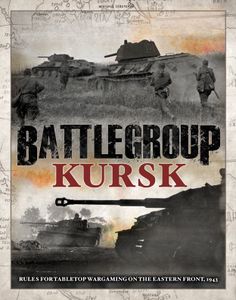
In an earlier blog post about whether to get the new Bolt Action WW2 rules, I mentioned some other rules I had tried, and I considered revisiting Chain of Command (CoC). When I went to my rules shelf I noticed a rules bundle I had purchased at a B&B stall (I can’t remember where or when) and I had never untied, or looked at them, once I had got home. These were the hardback books Battlegroup Kursk (BGK), the Battlegroup Overlord supplement and an A5 softback version of the rules (all together costing me only £20 compared to a RRP of £70!). So, rather than play CoC again, I decided to give BGK a go. I have managed to play a few solo games all using Eastern front 20mm forces on a 6’x4’ table and 250 points (i.e. Squad level game).

The ‘Orders’ section of rules is straightforward; all the standard, obvious options are available and include reactive orders, allowing covering fire etc. The reactive movement (rather than the reactive fire) order is a bit strange, and I never used this in my games. The turn order is IGO-UGO and number of orders available to a player results from a single D6 roll plus the number of officers in the force, which can give widely fluctuating results. Larger games use multiple D6’s and give a more standard range of results. Some things were not clear: German infantry sections have 2 teams (rifle and LMG) and I was not sure whether this needed a single order (in which case, why have separate teams listed), or individual orders (in which case, the German player will struggle with the number of orders required)? Reading the Overlord supplement, I found a rule for separating Bren teams from their sections in the British listing, and I decided to use this for the German sections/teams in my games (I’m still not sure if this is correct). I also was not clear about man-portable heavy weapon teams (HMG, mortars etc.), because there did not appear a requirement to set them up; could they simply move and fire like normal infantry teams, or should they be considered as Very Light weapons teams and need an ‘unlimber’ phase before firing?

The ‘Movement’ section is again nice and simple, but maybe too simple? There is no deduction for infantry movement in rough/difficult terrain. OK I can live with this, but I instinctively feel that marshes, woods, hedgerows etc. would have an impact. What do you class man-portable heavy weapons as? I think lugging a heavy base-plate for a mortar would significantly slow you down. Tracked armoured vehicles can weave about with no apparent deduction; I had a T-34 move down a road in a village, take a sharp 90 degree turn, then make another 90 degree turn around the side of a house, and then another sharp turn to face the enemy, all with no speed reduction.

The ‘Direct Fire’ mechanisms are again streamlined, all basically following the same procedure: observation, hit, save/penetration. I quite liked the fact you may not necessarily see the target and therefore not fire; and also liked the differentiation between firing for effect and pinning/covering fire. Pinning is pretty much as valuable as killing targets, due to morale effects discussed later. I had no major quibbles about weapon ratings etc., except possibly the German MG34/42 is over-rated? A rule that I used frequently was when a squad was trying to close assault; if multiple casualties are inflicted, you can instead take a single loss, retreat back to cover and become pinned. The vehicle listing seems to indicate that players should record the number of rounds fired. Really? I ignored this in my games – Life is too short for such nonsense!

The ‘Indirect Fire’ section follows a similar process but does raise some issues. I liked the ‘Communications’ aspect for calling higher command support, but this does burn a players order count. The accuracy dice roll again seems a bit random, and you can cancel the fire order if the ranging round falls short. There is no ability to ‘walk-in’ the artillery in subsequent turns, and the danger zone is standardised and not related to the calibre and number of weapons firing. The biggest omission is the lack of smoke rules, which is very strange indeed!

The ‘Morale’ section can be split into two. At a unit level, a casualty or non-penetrating hit results in a simple D6 dice roll, Veteran/Elite troops can re-roll, but this seemed to me to be too simplistic. Troops that are already ‘Pinned’ and fail, rout off. If a player rolls a straight 6, then the unit has a chance to take an immediate counter-action. At the battlegroup level, each force has a numeric strength and morale effects result in the random drawing of ‘Chits’ that reduce this value. I really like the uncertainty this mechanism introduces, particularly because it can result in occasional side effects e.g. mine strike, air strike etc. Reduction of battlegroup morale to zero results in defeat. Strangely, rallying unit/units from Pinning requires the drawing of a chit to rally D6 units. It would seem that waiting for the number of Pinned units to rise before rallying would be sensible, but this is often not practical. Units that tend to be pinned are those at the focal point of your plans, so you cannot wait to get them active again, and therefore you have to rally even if only a single unit needs such treatment. I have found games to be frequently lost simply by the effects of pinning opposing units, and obliging an opponent to rally. Maybe my game play and/or tactics are at fault, and I would be interested to hear what other gamers think?

Before I discuss the non-rules aspects of the BGK publications, I will comment about the type of game they give. I like the speed of play, the mechanisms are clean and simple, and the use of chits to determine victory is good. The order system is fine but rather random when using ‘Squad’ level games. Combat is clear and does not require constant double checking in the main rules. The main weakness lie in the unit morale system (too simple) and rallying. The lack of smoke rules is bizarre! Overall, I cannot see BGK becoming my go-to WW2 rules. I will stick to CoC, which I think gives a better game, and I also still intend to try the new version of Bolt Action.
The A5 paperback rules are excellent (only £10). Regarding the hardback publications (£25-30 each), I would be very disappointed if I had purchased them at the normal price. Why do authors think they have to provide pages and pages of potted history in such publications? If a reader wants historical background then there are a wealth of sources, online or published, that can be easily accessed and  provides for all needs, in greater detail and accuracy than provided in these rule publications. They then add in a simple painting guide as well. Do they think a person buys BGK as their sole source on a period, especially ones as well documented as Kursk or Overlord? I’m sorry to say that I find this ‘fluff’ annoying, especially because it’s inclusion bulks up the book and results in increased cost for little benefit. The majority of both hardback books centre on army lists. I generally enjoy a good army list. I find they inspire me to investigate/get new units, and I like the way they constrain players to field forces that feature the common elements used historically. There are poor army lists out there, which some players can exploit to generate ‘super’ armies but, on the whole, I like an army list. The lists provided in Battle Group Kursk/Overlord are bad! Not because they are inaccurate, unhistorical, or unbalanced, but because they are extremely repetitious and tedious. For example BGK has only 4 lists: German Panzer & Infantry, Russian Tank & Infantry. This is fine, but each list repeats the information in the previous list. They share the same elements on the whole; a German infantry platoon/squad is the same in both German listings, as are the tank units, support units, recce units etc. etc. I’m sure there must be a few variations between lists, but 90%+ of each list is repeated information. The format of the army lists is again poor; each list takes a dozen sides of A4, when a better format could easily reduce this to a couple of pages! With a bit of thought and editing the authors could reduce the entire rules to the A5 rules booklet and separate, smaller, slimmer, A5 army listings. Even better would be to publish the army lists online as free pdf files! Such a decision would make BGK an attractive purchase, but in the present form I would not recommend these rules to another gamer! What is even more astounding is the authors are producing further campaign dedicated hardback books! Rather than finish on a negative note, I do like the inclusion of minor, often neglected, support elements e.g. combat medics, signallers, repair mechanics etc.

Saturday, 1 October 2016

Bolt Action 2; Yes or No?


When Graham recently visited for a gaming weekend, he mentioned the only non-Flames of War game he had played in the last few months was Bolt Action, and he indicated that he thought they gave a reasonable game. I have only played a single game of Bolt Action and then only half-heartedly; a small club game that I was invited to join when I had no game of my own planned. I must admit that I did not fully participate or concentrate, and spent most of my time chatting to other gamers about this and that. I recall that I was initially confused about the command dice, thinking that you had to roll them to ascertain you order type (clearly wrong), and my fellow players did all the calculations, simply telling me how many dice to roll and what I required. I remember we were British infantry, with some armour support, and we were hammered by the Germans who were armed with assault rifles and plenty of MG42’s. Snipers were also a pain, picking off targets at will, although officers/leaders did not seem to have any beneficial effects. My partner muttered about the Germans having a ‘gamey’ list choice, but I was just happy rolling some dice and enjoying myself, rather than worrying about winning or losing. Soon after Graham departed, I noticed reports that Bolt Action version 2 was about to be released, and my interest was piqued. I have since checked them out online and read a few battle reports.

WW2 has never been a major gaming interest for me, but I have dabbled and own a reasonable number of 20mm troops for the main European participants, and these have sat in their box files for many years. I have tried numerous rules; the simplistic (Rapid Fire), the flashy (Battlefront WW2), the innovative (Crossfire) and the popular (FoW), none of which has grabbed my attention. More recently I have played Chain of Command which I did enjoy but surprisingly, after the initial burst of enthusiasm, they have remained largely on my rules shelf.

So, the question is: Should I invest in Bolt Action 2? Are they any good? Or, am I not cut out for WW2 games? I ‘think’ I want a fast action set of rules focussed on Platoon/Company level infantry action, which can accommodate some armour (which is not over-powering), and which does provide a good degree of period ‘feel’. What I mean by ‘feel’ is some variation in the tactical approach used by the different nations, and forces that don’t just take part in a dice-fest, but instead use covering fire etc. to set up attacks, and do not fight on to the last man standing.

Any thoughts, opinions or advice out there? I have a month or so before they are released, and maybe I will dust off Chain of Command and see if I can wet my WW2 appetite again.

Monday, 17 November 2014

Flames of War?


Last Saturday (15 Nov 2014) I went to the Warfare show in Reading. I try to attend this show every year because it provides an ideal opportunity to stock my lead pile prior to the approaching festive period. This year my shopping requirements were heightened due to the cancellation of the September show, Colours. As usual I met up with my long time gaming friend, Graham, who was playing in the Flames of War (FoW) competition. Graham is a keen competition gamer who has focussed on FoW for a few years now and I have seen him play many times. Clearly FoW are a set of rules he very much enjoys and I find it strange that this set of rules has never truly grabbed my attention. My feelings towards FoW are ambivalent, which is strange because most gamers seem to either love or hate them, with little in between. I hope by writing this post I can perhaps clarify my thoughts and move towards solving the conundrum posed by FoW.

I should state that I have all 3 versions of the rules and many of the supplements, most of which I bought via ‘Bring and Buy’ stalls. I think these purchases were worth buying if only for the eye-candy they contain; many excellent photos of figures and vehicles, short background articles and OOB’s.  I have also been moved to buy and paint 2 matched armies (mid-war DAK and 8th Army), but they have only been used 3-4 times and spend their life in boxes under my wargames table. Why is this? Why doesn’t FoW appeal to me in the way it clearly does to many others? Or should the question be re-phrased, why was I motivated by FoW to spend money on these armies?

I think I will start by examining what I see as the significant positives about FoW. They are beautifully presented publications that certainly hooked me and prised open my wallet a few times. I suspect there are too many supplements and they are now going into diverse areas (WW1, Vietnam etc.), which is strange considering there are still many WW2 theatres not covered (I am thinking especially of the Pacific war). The rules themselves are clearly written and have simple basic mechanics. This is not to say that the rules are simple because there are numerous unit, weapon, nationality etc. specific rules and modifications that tailor an army’s performance to their historical counterparts. How well this is achieved I will not comment on here because of limited space and time! There is a strong element of luck within the game, but FoW is not a dice-fest and after watching many competitive games I think I can appreciate the skill and knowledge that players display. In fact I think the luck element has a huge positive impact on the competitive wargaming scene. Competitive FoW players seem to have more fun than other competitive gamers; they laugh more, they realise that the dice gods can undermine the best of plans, they accept defeat more gracefully, and pick themselves up to go again. I do find it disturbing how many competitive FoW players can reel off weapon stats and points values from memory and argue about whether taking a PaK40 platoon represents value or not! I’m sure I would drive them crazy, slowing down play by constantly referring back to lists. They don’t even seem to require a QRS to play! The next major positive about FoW is more general: As a whole I think FoW armies are some of the best painted and modelled miniatures that can be seen within the competitive wargaming environment. Walking around the other wargame competitions I am always shocked about how varied the quality of armies are: some are good but a surprising number are poor (partly painted and bashed figures, temporary basing, and even occasionally unpainted figures). FoW gamers seem to take pride in their collections and take any opportunity to add vignettes to boost the character of their force. I also like the more obscure forces (Hungarian, Finnish etc.) frequently fielded by players, and any rules that encourages players to use early war French or Italian armies should be commended. I do think that Battlefront miniatures are over-priced and this has certainly deterred me from jumping into FoW with more enthusiasm. Another aspect of FoW I really appreciate are the different missions available. They shift gamers away from the bland meeting engagement and enable more varied, challenging scenarios to be played out. Even though I’m not a FoW player I do use the different missions with other gaming rules.

With all these positives, what puts me off using FoW? There are some problems with the mechanics. Some players have commented that FoW is merely a WW2 version of 40K. I have never played 40K so cannot say if this is correct (or even if this is a bad thing!) but I do feel there are some basic omissions and problems. There is no overwatch mechanic which strikes me as bizarre and would have been easy to correct with little added complexity for the game system. The bailing/remounting mechanic is understandable from a game perspective but it is funny having tank crews acting like demented jack-in-the-box characters. I have frequently seen players using massed tanks moving bumper-to-bumper like formation dance teams. Tanks seem able to perform amazing feats of driving agility such as turning on a sixpence in narrow lanes, all the while maintaining perfect formation. Having artillery on-table when they should be miles to the rear (scalability has always been a bugbear for rules authors but this is taking it to the extreme). Then scattering your artillery battery across the whole baseline rather than keeping it as a coherent formation. It appears the primary role for air defence units is frontline ground attack close support. I could go on and on, and I’m sure other gamers would refute each and every point I raise, but from my perspective FoW does not simulate WW2 tactics/action well. I have no personal military or combat experience to base this assertion and it is merely a reflection of my reading of accounts and histories. It fact, it can be argued (correctly in my opinion) that no wargame rules come close to accurately simulating combat in any period of history, but I feel FoW is a poorer simulation than other WW2 rules on the market.
To conclude, FoW is not for me. I am glad FoW exists and that so many gamers enjoy playing. It has re-invigorated WW2 gaming and has brought many new gamers in to the fold. It has improved the painting and modelling standards within the competitive gaming community. Long live Flames of War...but can I play another, different game, please? (Now I will put my steel helmet on, go to ground, dig in and await the flak. Let’s hope my opponent has not invested in combat engineers with flamethrowers!).