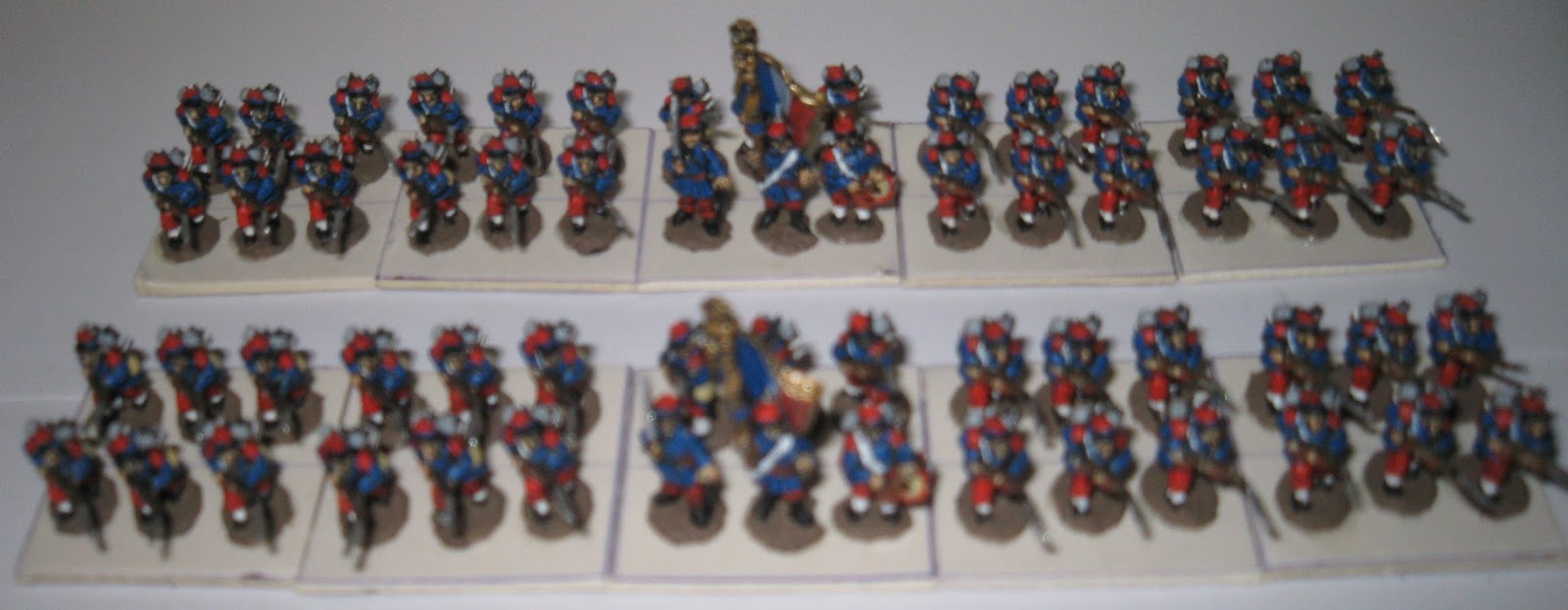
I have completed my FPW 10mm Prussians in record time! I’m
only showing a few in the photo below, but in total I have completed 20 bases
of infantry, 6 bases of jagers, 5 bases of dragoons and 6 bases of artillery. I
plan on painting my 1859/66 Austrians next but I need to by a few more packs
first. The army pack I bought did not have any command figures and I want a few
rockets as well. I cannot face base texturing at the moment, so this will wait
until I have finished painting all the figures for this period.
Tuesday, 10 May 2016
Monday, 25 April 2016
Off the Painting Table (April 2016); part 2
I have had some ‘free’ time this week or so, and have
pressed ahead with painting my 10mm FPW French troops. Progress has been
excellent and I have completed the remaining figures: 10 bases of Line
infantry, 6 bases of Chasseurs, 5 bases of cavalry, generals and 9 bases of
artillery! A few photos below (the Chasseurs are out of focus, sorry). Next up
are the Prussian opponents.
| French Line Infantry |
| French Chasseurs |
| French Artillery |
| French Cuirassiers and Generals |
Sunday, 17 April 2016
Off the Painting Table (Apr 2016)
It has been a while since my bushes were used due to my
indecision about what project to undertake next. Inspired by the Bloody Big
Battles (BBB) rules I decided to buy some Pendraken 10mm armies for the
Franco-Prussian War.
The first batch painted was 10 bases of French infantry. I
chose a fairly bright blue for the tunic so the French army would contrast with
a more blue-black colour to be used for the Prussians. The amount of detail on
the castings is excellent and I am happy with the results obtained. The French
look suitably bright and should stand out on the battlefield. I have not
textured the bases yet because this can wait until the army is complete. The
next group to be painted will be another 10 bases of French infantry, these
will be followed by French chasseurs, artillery and finally cavalry. The
Prussian forces will then follow, so I should have a few months of painting
ahead.
On Saturday I visited the massive Salute show at Excel,
London. The theme was ‘Steam Punk’ but this was not especially evident; I was
expecting plenty of re-enactors and numerous demo games. The only re-enactors
were the usual Star Wars Imperial troopers, and there was no preponderance of
themed games, just the usual number of small scale games of Malifaux etc. There
were a few zombie games but these hold little interest for me. I took no photos
and others write better show reviews on various blogs, so the games that stood
out for me included:
Vietnam game (25mm) by Essex
Gamesters - beautiful battlefield and civilians.
ECW Siege of Bristol (28mm) by Crewe
& Nantwich Club – great set up, not sure how works as a playable wargame.
Napoleonic Peninsular (28mm) by
Victrix – beautiful but again not sure if playable.
SYW game (28mm) by Bill Gaskin –
the most stunning game in the show in my opinion.
My Salute purchases included some trees from Last Valley,
more 10mm Pendraken figures (1860’s Austrians), a copy of Bloody Big European
Battles, a copy of Dropzone Commander (not sure why I bought this!). I resisted
buying the new Baroque rules or the new ECW ‘The Kingdom is Ours’ rules from James
Daniels. I was tempted by Horizon Wars by Osprey but these will wait until I have
read a few reviews. The Chicago Way gangster rules by Great Escape Games almost
got bought but I manfully resisted! I was interested to see Tomahawk Studios
will be releasing a colonial set of rules, Congo, later in the year.
Whilst at Salute I bumped into my wargaming
friend, Ian. We sat down to play a demo game of Peter Pig ACW riverine rules, ‘Hammering
Iron’. I took the Union monitor force versus Ian with the Rebel force of
Ironclads and steamers. Other players joined us, and a boy (13-14 years old)
joined me and took control of the USS Monitor. What followed was an amazing game.
My companion successively fired on 3 different Rebel vessels, each time doing
enough damage to produce a critical hit dice roll: he rolled double 6 three
times in a row, blowing up the enemy ships! The look on Ian’s face, his fellow
Rebel players, and the game Umpires was a sight to remember. Ian and I later
calculated the probability of 3 successive double 6’s to be 46,650:1 !!! I hope
the luck has rubbed off on me!
Monday, 11 April 2016
Boardgame session: 10Apr2016
Our
regular gaming friends, Val and Chris, visited and I decided to try Merchants
and Marauders and a 4-player game. This is a game I have only previously played
as a 2-player game with my wife, and we both enjoyed the game play, although Elaine always goes for the Merchant
side of things. The game can be long and difficult to explain, with many
variables and rules involved. I think the pre-game explanation went well, and both
Elaine and Chris clearly went for the Merchant role whilst Val and I opted for
a more aggressive, Marauder approach.
Although Chris won, I think Elaine could claim the moral
victory because she could have won 2 turns earlier but carried on for the sake
of the game. I think Elaine needs to toughen up because I don’t think either of
the rest of us would do the same.
Merchants and Marauders is a long game and this game took 4
hours. It is visually very attractive and thematic, but has possibly too much
going on! The specific rules for each sea area frequently get overlooked, and
none of the players really maximised on the advantages these rules could have
delivered. Everyone agreed that sea battles take too long and break the flow of
the game. The results of this game re-enforce the view that Marauding is not
the best route to success, but I remain convinced that if done correctly then pirates
can achieve victory. With hindsight I think a player should not start
aggressively; a Marauder should acquire some wealth by trade before embarking
on a lawless career. He certainly needs to purchase some special weapons, and possibly
ship modifications, before starting any Merchant Raids. I am beginning to think
that a Marauding life should only start once a Frigate is purchased.
To conclude, I hope all players enjoyed the
game. We all got into the theme of the game and took pleasure trying to play adverse
cards on opponents; for example I tried to ‘Frame’ Chris, whilst Elaine
increased the bounty on my head etc. I can see us playing future games of
Merchants and Marauders but not that often as it takes too long and is too
involved.
Saturday, 2 April 2016
AAR; Pony Wars; solo (Din of Battle v2) 31 Mar 2016
I had a free day and decided to revisit the Piquet variant
Din of Battle rules in combination with my 15mm US cavalry and Lakota native
American armies. I played a simple encounter battle with 5 US cavalry units
with some Crow scouts attacking 8 Lakota units, half mounted and half on foot.
The battlefield was fairly open with gentle low hills and a scattering of woods.
The game was played lengthwise on the 6 foot table. As there were less than 18
units in total, the initiative dicing used opposed D12 rather than D20 dice.
The US cavalry activated first and came rapidly on to the
table in columns, and then they advanced a second time to almost the half-way
point. Now the initiative changed and the Lakota side won a succession of
opposed rolls. They very rapidly advanced, both cavalry and foot, in ‘mass’
formation. The US cavalry were now in a very precarious position, still in
column, and were desperate to both win back the initiative and draw
‘deployment’ cards.
The Indians charged in to the cavalry columns, firing as
they came, and now hoped to draw ‘melee’ cards from their deck. Fortunately on
the Indian right flank the Lakota firing disordered the US Crow scouts allowing
immediate melee combat. The scouts were routed and the supporting cavalry were
engaged. In the centre the US cavalry did draw 2 ‘deployment’ cards in quick
succession allowing them to get into line and then dismount. They now poured
carbine fire into the Indians, routing a couple of units. Unfortunately this
was not enough, the Lakota drew the required ‘melee’ cards and another couple
of cavalry units were routed and the US cavalry right flank was totally
destroyed. Both sides were now struggling due to a lack of morale chits, but it
was clear that the Lakota had won. They had a couple of mounted units working around
the open flank behind the diminished US cavalry force and the army commander
would have no choice but to get the hell out of there with what was left of his
forces.
The game moved at a rapid pace. The prime error by the US
cavalry was to remain in column too long. They needed to deploy into line well
away from the on rushing Indians, then dismount and use their firepower to win
the game. The widely fluctuating initiative system employed by the rules
allowed the Lakota to get the jump on the government forces and gain the win.
Din of Battle (and the other Piquet variants) are excellent solo rules but the
luck element, which is integral to the rules, would I feel make the game frustrating
in a 2-player situation.
I have ‘found’ on my computer a variant set of
Pony War rules produced by The Perfect Captain and I hope to try these out as
an alternative to Din of Battle.
Subscribe to:
Posts (Atom)