Wednesday, 4 September 2019

Review of the wargaming year 2018-19


The fifth year of my blog has now been completed and the number of hits still seems to be rising but only slowly (up 9% on the previous year). The audience appears to be consistent, with USA, Russia and UK dominating, but a good number of European readers spread across the continent. Most interest concerns new rule sets (e.g. Saga v2, Impetus v2), but there are more views on posts related to my painting progress than in previous years. Boardgaming also continues to be highly viewed (see my next post on the Boardgame Year). I still would like to see more comments but overall I’m happy with how the blog has gone. The main purpose is to keep a sort of diary of my activities for my own record, and I’m happy that others may find this interesting.

The games I have played this year are listed below:

 
Period
Rules
Type
Scale
1
Ancient
Impetus; EIR vs Germans
OpposedL
28mm
1
Napoleonic
Grande Armee
Solo
6mm
1
Ancient
TTS: Lysimachid v Thrace
OpposedL
15mm
1
Medieval
Saga: Teutonic v Pagan
OpposedL
28mm
1
Ancient
S&S; Persian v Indian
OpposedL
15mm
2
Dark Ages
Saga: Viking v Anglo-Danes
Saga: Normans v Scots
OpposedW
OpposedW
28mm
1
Ancient
S&S: Succesor v Greek
OpposedD
15mm
1
Ancient
Impetus2; Punic Wars
OpposedL
15mm
2
WW2
Chain of Command
Solo
20mm
2
Napoleonic
Sharp Practice
Solo
28mm
1
Pirates
Blood and Plunder
Solo
28mm
1
Modern
Cold War Commander
Solo
6mm
1
AWI
Washington’s Army
OpposedD
15mm
1
Ancient
Impetus; Han Chinese
OpposedL
15mm


I have played a similar number of games compared to last year but more of these have been opposed games rather than solo efforts, but I continue to lose more than I win!

The wargame highlights of the year must be the new editions of Impetus and Saga, both of which I think are improvements on their earlier versions. I enjoyed trying the “To The Strongest” rules and think they give a good game. I have also started to revisit other rules that I feel have been neglected, such as “Blood & Plunder”, and I hope to get my pirates on the table soon.
In summary 2018-19 has been a very quiet year. I continue to say that I must play more regularly, but life just seems to get in the way! I don’t have any specific plans in mind for next year projects, but the upcoming Colours show in Newbury may help.

Monday, 2 September 2019

AAR: Han Chinese (Impetus v2) 1Sept19


This was the first outing for my 15mm Han Chinese armies, and only the second use of the Impetus 2nd edition rules. I worked out two 400 point armies representing the Eastern and Western Han armies (very similar to each other), and I randomly got the Western Han. Both armies had 3 commands, and all the commanders were rated as ‘Reliable’. The terrain selection procedure resulted in another open field of battle, with a small difficult hill on one flank and a field of crops on the other flank. I personally think the terrain selection part of these rules are very weak and too often produce featureless battlefields.
My Western Han deployed on the right
(Notice my deployment error!)


Ian deployed his army in a conventional manner with a central infantry command flanked on each side by cavalry commands. I was going to have a similar deployment, but after placing my central infantry command, I changed my mind and decided to place both my cavalry commands both on my right flank. I hoped to overwhelm Ian’s cavalry and press in on his centre. I was to learn an important lesson: Never (!), never (!!) change your battle plan on a whim and halfway through your deployment (!!!). I soon realised that I did not have the space to manoeuvre both cavalry commands between my infantry force and the difficult hill on that flank. Attempting to overcome this bottleneck slowed my advance, disorganised the units and lead to congestion. In addition my central command needed to be nearer the crop field on the other flank, which meant it was dangerously exposed.
My central infantry command under pressure


Disaster rapidly came! My unit of heavy chariots failed to unplug the pinch-point, they were then destroyed by a counterpunch from Ian’s elite cavalry, who went on to knock out further units in their pursuit. In just a couple of turns my army was in disarray and taking heavy losses. Meanwhile on the other flank, Ian’s unopposed cavalry command was wreaking havoc on my exposed infantry. Thankfully I was swiftly put out of my misery, as first one command routed and then the army morale collapsed soon after.
My losses rapidly mount!


This heavy defeat was solely down to my stupid deployment and change of battleplan! The Impetus v2 rules work well but do take time getting used to. I like the changes and clarifications to the charge reactions: the options to evade/counter-charge/defensive fire etc. are much clearer. I also like the reactive fire options, and these were one of the changes it was most difficult to remember to enact. The only criticisms I have concern the terrain selection mechanism, and possibly, the victory conditions. It feels that the loss of a single command rapidly progresses to the loss of the whole army, whereas I would prefer a more gradual, nuanced approach.
Overall, an instructive game for me and I am keen to play more Impetus v2 games. The Han Chinese armies are interesting to use. I noted that bolt-throwers are useful against ‘large’ formations, and the crossbow armed cavalry are more effective than I originally thought.

Monday, 12 August 2019

AAR; AWI (Washington's Army, RFCM) 11Aug19


This game was arranged by Ian using his beautiful AWI figures and terrain. I played using a fairly regular American Continental force versus Ian using a more irregular British Southern force of loyalists. The rules we used were Washington’ Army (RFCM). Like most Peter Pig (RFCM) rules the game starts with a pre-game phase, which determines attacker/defender, terrain placement, delays/reinforcements, flank marches, officer quality etc. etc. This process does take some time and involves much dice rolling, but does allow significant choices to be made and results in a less predicable, and asymmetric, set up.

As the American player I was determined to be the defender, and as a result some of my units suffered losses and others were delayed as reinforcements. My flanking forces was only small (1 unit of raw militia) as opposed to Ian’s strong 3 unit force. Ian’s generals were better quality than mine, but I was lucky and a sharpshooter killed his C-in-C before the battle started.

I determined to hold a solid defensive front with my regulars and force Ian to attack across the open ground. I was concerned by my flank objectives which were only weakly defended.
Americans on the right defending the road between the river and stream.


On my right flank a single regular Continental unit lined a rail fence. Ian’s attack suffered a stuttering start and took some casualties before finally forcing my forces back from the fence, exposing the objective marker. In the centre the British attack moved faster but was met by good fire from my main Continental line and artillery. My militia skirmishers battered their opposing British skirmishers. The situation looked comfortable for the Americans, but events on the far left flank were to prove ‘interesting’! Ian’s sole unit of mounted light dragoons rapidly advanced, by-passed my militia in a town, and speedily took the centre objective on a hill in the rear of my centre position. I did receive some reinforcing militia and artillery, who moved to contest this situation. I thought Ian would dismount and hold his position, but instead he charged my centre forces in the rear. I lost my artillery unit, but before Ian could fully exploit his advantage, I managed to get a veteran Continental unit to change facing and counter-charge the British cavalry in the flank. The cavalry routed and disaster was averted. This move did expose the Continentals to a British charge in their rear by a nearby unit. I was very lucky, and rolled good dice; the charge was repulsed, my veterans survived and re-took the centre objective.
British centre force (left) about to receive a battering from the Continental line.


In the last turn we played, the British flanking force turned up on my left flank but I did have some militia present to contest the objective. We did not have time to finish the game (there were probably 2 more turns still to play), so the game was drawn. I think Ian would have control of my right flank objective, whilst I controlled the centre objective, where Ian’s centre attack was severely mauled. On my left, I don’t think Ian had time to force me off the objective, so this would remain contested.

The game played at a nice pace and was enjoyable. I think the pre-game process is good, but takes maybe too long, and this meant the main game was not finished in the 4 hours we played. I feel the time taken would be less if we were more familiar with the rules. The core rule mechanics follow the same systems common to most Peter Pig rules and are very easy to remember and use. I find the save mechanism for hits to be a bit too easy but this is just a personal gripe; saving on anything but a ‘1’ too often means a good volley of hits achieves no appreciable effect. I’m also not convinced by the ‘Determination’ dice roll mechanism that appears to be unique to this rule set.

Anyway, my thanks go to Ian for putting on this game. His armies are lovely to look at, and he always supplies an excellent array of game markers etc. that make play easy.

Monday, 5 August 2019

Off the Painting Table (Aug 2019)


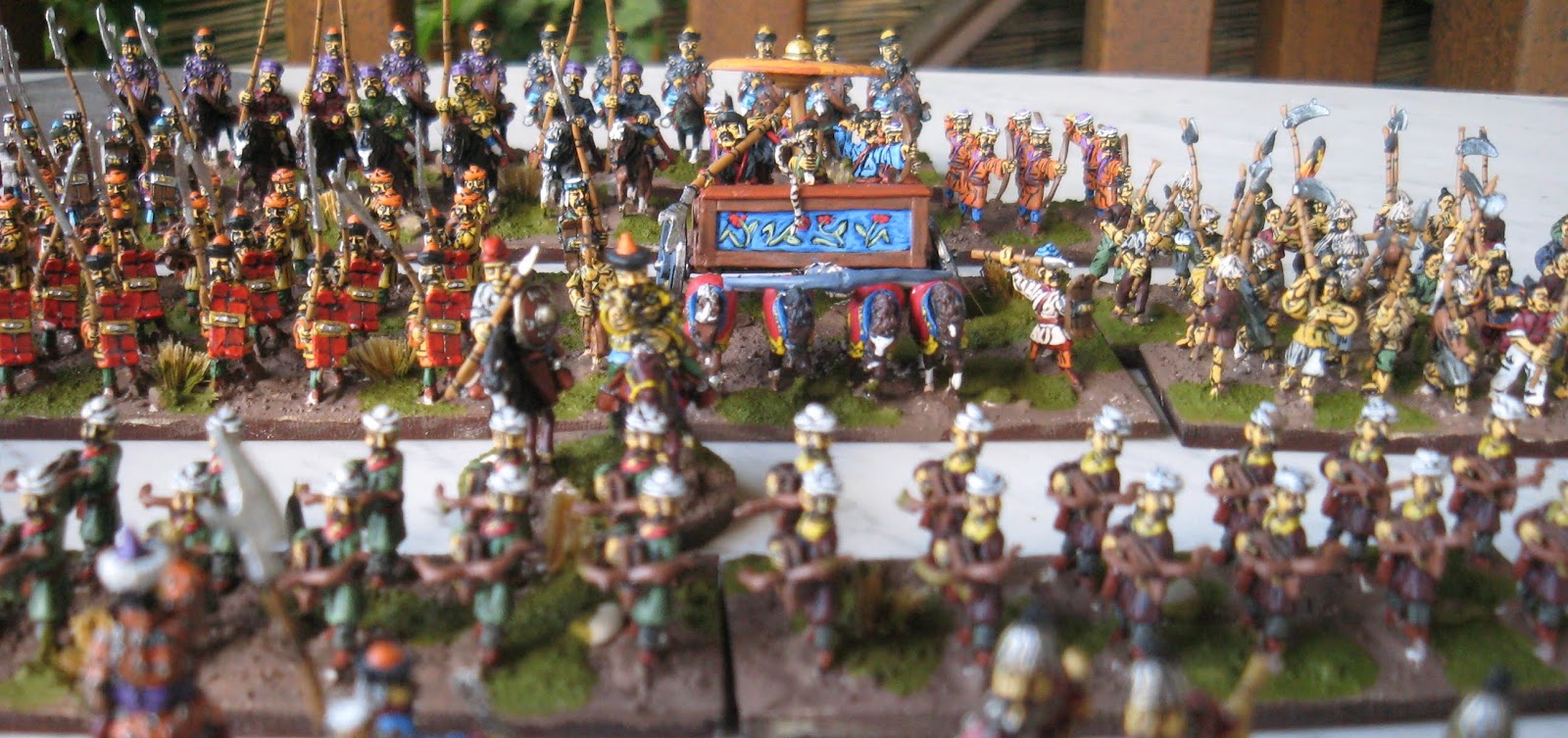
I have finally finished my Han Chinese armies!


I feel relieved to have completed this project; it dragged on a bit with so many crossbowmen. Overall I’m fairly happy with the results. The Lancashire Games figures look OK. I did not go for a ‘uniform’ look across the army, but did give most units a uniform colour scheme within the unit. I plan to use these armies as Han and late Warring States forces, and they should morph nicely.


I have almost 900 points (Impetus) in total, so I can easily field pairs of armies with a range of variations. I have 4 units of peasants, so rebellious Yellow Scarf or Red Eyebrow forces can be fielded.


Their first outing will use the Impetus rules, but I want to draw up some Sword and Spear lists to use as an alternative.

Monday, 22 July 2019

Show Report; Attack, Devizes 2019


My ‘local’ club in Devizes held its annual show, ‘Attack’ this weekend. I felt it was quieter than usual, but the entry numbers were good and the car park filled nicely. Also the traders all seemed to be doing well. I think the most impressive game was a 15mm Stalingrad game (I forget who put the game on), the terrain was excellent. The strange thing about such games is that nothing seems to happen; I observed the game throughout the show, and could not see any meaningful progress, maybe this is historical. The competition gaming was going strong, but the FoW group was much reduced, whilst the Bolt Action crowd was bigger; is this a trend in the WW2 sphere? There was also an active Saga competition that friends said they greatly enjoyed.

I managed to catch-up with friends and do some shopping, but I was not inspired, so I spent very little: I bought the modern Seven Days to the River Rhine rules (Great Escape Games), plus a couple to carts (Col Bills) and box of early C18 French Infantry. I saw nothing on the Bring and Buy stall that took my fancy, which is unusual. My attendance is largely to help to set up and take down the tables etc., and my thanks (and those of the club) should be given to the organisers and club volunteers who put in so much effort. I look forward to next years show!

Monday, 15 July 2019

Boardgame session: 14 July 2019


Elaine and I have played, and enjoyed, a number of games of Western Legends. I was therefore very interested in how the game would play with more players, and this Sunday we got a chance to try it out.

Firstly there is no ‘Man in Black’ chasing you around the board doing almost random damage. I really like this mechanism to allow 2-player games, but it is not required in larger player counts. There is much more direct player interaction when the player count increases, but it takes time for new players to appreciate the need to attack others. In our group there is also a tendency to follow the Marshal points pathway, rather than the more uncertain Wanted path to glory. I kept to my character (Jessie James) profile and robbed as much as possible, but being the only Wanted player, I did get the attention of the Sheriff more than I would have liked. The Story Cards are more rapidly completed compared to the 2-player version. The increased player count does slow the game, and we found the short (15 point) game took roughly 2½ hours to complete. All the various location actions were utilised, and all players realised the value of the Cabaret in turning money in to Legendary Points near the end of the game. Chris (Bloody Knife) was the clear winner by managing to find 4 gold nuggets, depositing them successfully at the bank (together with some Fools Gold) and quickly spending the money on a blow-out at the Cabaret, thereby earning a large number of Legendary Points in quick time. Unfortunately neither Elaine (YB Rowdy) nor I could intervene to stop him due to our location on the far side of the board! Val (Billy the Kid) progressed steadily, mainly focussed on stealing cattle and being a skilled poker player! Chris clearly won, but the final scores for each other player were fairly close.

I hope all enjoyed playing the game, and I think they did, but it is difficult to judge when you are  playing, explaining and running a particular ‘new’ boardgame. I’m sure further plays will be faster now all are familiar with the concepts and options. I think both 2-player and multi-player versions are equally good, but do offer different experiences. For the multi-player game to work, players have to accept the need for their characters to interact and fight frequently. The fact there is no player elimination, and that wounds are a mere inconvenience, should encourage such behaviour.

Friday, 12 July 2019

Off the Painting Table (July 2019) part 2


The Western theme continues. I bought a box of 20 Wild West figures produced by Blue Moon whilst at the Partizan show a few months back. Any Western town needs a good smattering of civilians to add colour and break up play a little, so these figures will do nicely.

The figures are well produced and have a lot of character. The ‘soiled doves’ contrast nicely with the various shopkeepers and more prim townsmen and women.

I enjoy painting these small projects; they break up the ‘monotony’ of larger projects, such as my Han Chinese. I now feel re-energised to get back and complete those few pesky Chinese that have been awaiting my attention.