Monday, 26 March 2018

Boardgame Session; 25Mar18


There is a category of boardgames which we rarely play and which sit unloved on the shelves. These are Strategic, Combative, Area Control games. On my shelf I have a range of games that stretch back in time and include titles like Kingmaker, History of the World, Shogun, plus more modern games like Game of Thrones and Merchants & Marauders. There are many common reasons why such games are not played; the combative style, player elimination (or player diminution), a force build up focus which results in a lack of action, too many rules, player down-time etc. I think the dominant reason is the time commitment; these games take 3-4 hours minimum, and some, like Twilight Imperium, can easily double this! For some gamers the reasons listed are not a problem and they like the depth of the games, and enjoy expending the time and thought required to play a ‘good’ game. Personally I suspect I am such a gamer, which presumably explains why I continue to buy these games, even when I cannot get them on the table.
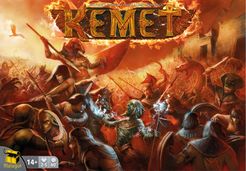
Therefore I have purchased yet another game of this ilk, Kemet, and I have hopes that it can overcome the barriers listed and see the light of day (occasionally). From reviews read, I have high expectations of success. The game is reported to play fast (roughly 1 hour), with combative action from the start, no player elimination, little down-time, plus lots of theme. So this Sunday we tried a 4 player game of Kemet. As I went through the rules I did see some glazing of eyes, which was a concern but may simply reflect my poor communication, but once we got playing it was clear that all players had picked up the gist of what they could/needed to do. From the start I adopted a highly aggressive approach because I wanted to emphasise the need to attack in the game, and I did not want the others to get in to a cautious mindset. With hindsight, I can see I was too aggressive because the other players snaffled all the nice upgrades and cool monsters, before making their moves. Soon everyone was attacking whenever there was an opportunity and after an hour or so, Chris emerged as the winner. Elaine and Val were close behind, whilst I trialled in last place. I was glad to hear that everyone enjoyed the game and would be willing to play again in the future! Elaine is slightly doubtful because she does not find any combative game to her taste. The components of Kemet are great; the board is colourful, I like the fact that each players units are different models, the monsters look great, the power tiles clear and the iconography self explanatory, the combat cards work well and the outcomes easy to resolve. The speed of play and constant action keep all players involved, in fact I would have personally liked the game to last a bit longer. To conclude, I am very happy with Kemet and although it is unlikely to be a ‘go-to’ game, I can see it making future appearances on the table. Unfortunately, I don’t think it will encourage our group to breakout the other games discussed earlier, so Shogun et al. will continue to sit in their boxes.
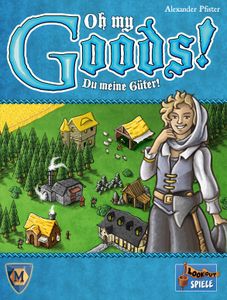
After Kemet, we tried the card game ‘Oh, My Goods’. Elaine and I had played the previous night and both enjoyed the mechanisms and combo possibilities the different cards present. The game worked equally well with 4 players, and Val won the first game (much to her surprise) and Chris the second game. In my limited experience the final scores are always tight, with only one or two points separating players, irrespective of how many buildings they have completed. There are many routes to success; getting an assistant is nice, building potential chains of production is good if you can make them work, simply producing goods can generate significant points. I’m sure our game play will improve with experience and as our knowledge of the cards grows. I like the speed of play and the good player scaling, it plays equally well with 2 through to 4 players. I can see this game being taken on holiday to act as a filler game in those quiet, downtime moments. I think there is a small expansion available and it is something I will investigate getting.

Monday, 12 March 2018

AAR Hittite v NK Egypt (Sword & Spear) 12Mar18


I have not met up with Ian for a few months and he wanted to get his newly painted Hittites on the table, so I gave him a match with my NK Egyptians. We were using Sword and Spear rules (S&S) with 350 point armies. The battlefield was very open although Ian restricted the width by placing a coastline on my right flank. Both our deployments matched up, with the medium foot facing off against each other near the coast, and the chariots opposing one another on the open flank. Because of the deployment we both expected this to be a bit of a slog, but it turned out to be anything but!
View from the Egyptian side, following deployment


Quite early in the game Ian’s Gasgan foot smashed a hole in my centre due to their ‘Impact’ ability, which I had forgotten to take into account. This was a bit of a surprise to both of us, although Ian clearly hoped this ability would yield an advantage in the initial stages of the combat. Meanwhile the chariot clash on the flank seemed balanced, especially after my Nubians KO’d a Hittite chariot unit by charging into its flank whilst it was engaged to its front. This proved to be the only highlight of the game from the Egyptian point of view. Unfortunately I had left a fresh Egyptian chariot unit (plus the flank Captain) exposed to a flank attack, which Ian duly administered. I thought I could survive for a turn at least, maybe suffering a hit or two which I could rally off reasonably easily. Instead the unit was KO’d (I failed all discipline tests for casualties) and in addition the Captain was killed. The destruction of this unit resulted in further tests for other close units, which were all duly failed because the lack of leadership and this chain reaction just blew my army apart!
Ian's victorious Hittites


All-in-all, a strange game and I’m not entirely sure why I lost. I cannot blame the ‘dice gods’ because both Ian and I threw poor rolls at times (Ian actually threw 3 dice for activation and got 3 1’s). I don’t feel I made catastrophic mistakes in deployment or tactical moves either. I certainly did not give the Gasgans enough respect, and allowing my chariot unit to be flanked were clear errors, but equally Ian must have been annoyed by my Nubians. With hindsight I could have avoided the flank attack on my chariot by moving it directly ahead and out of Ian’s path of attack, but I was confident I could survive the attack and punish the ‘pinned’ Hittites in following turns. I do think that luck deserted me at a few critical points such as when making discipline tests and this was combined with a degree of ‘rustiness’ with the S&S rules. I definitely need to play more games, and I congratulate Ian on a decisive victory!

Tuesday, 6 March 2018

Off the Painting Table (March 2017)


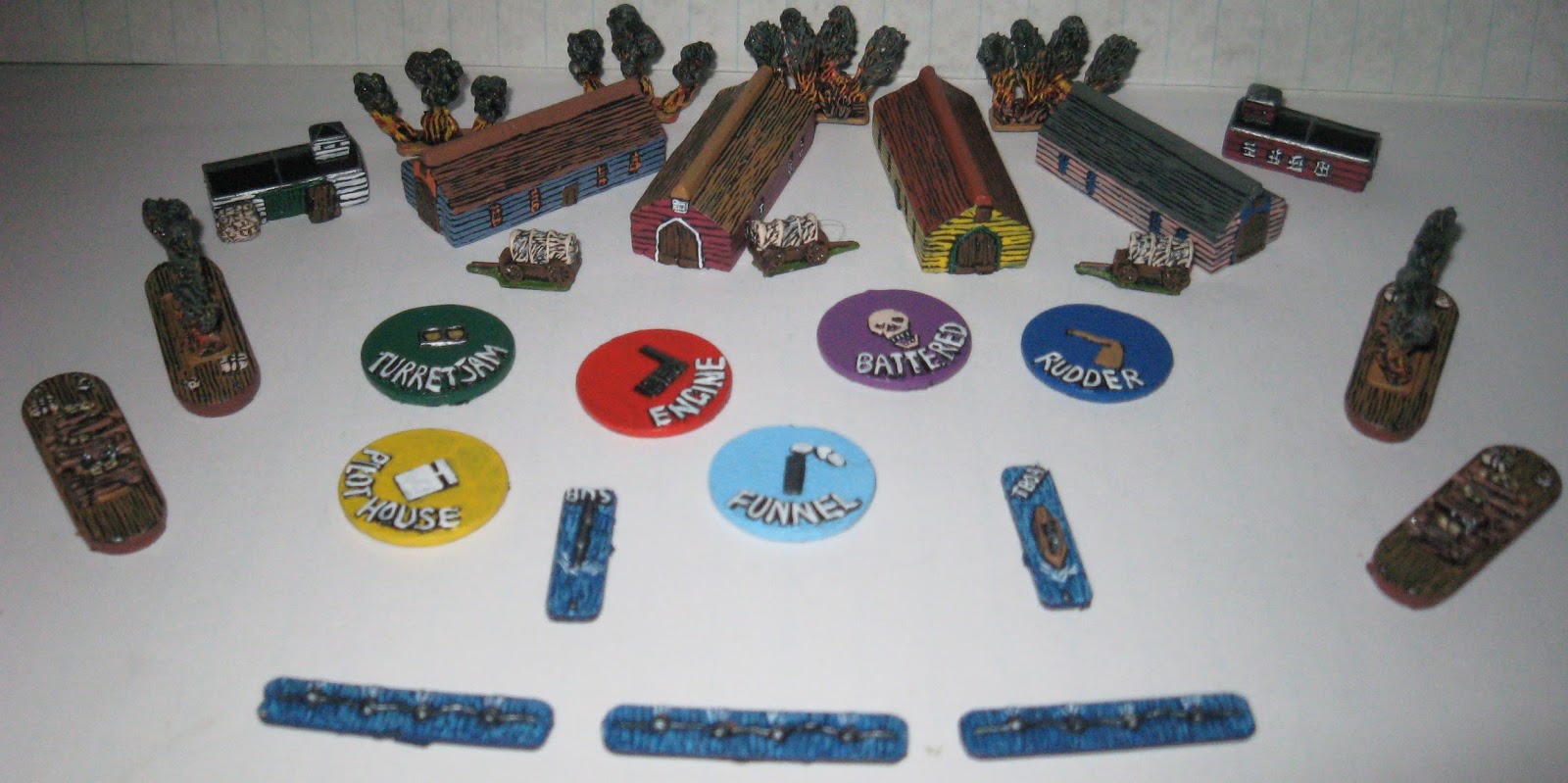
My latest project, ACW Riverine, has taken very little time to complete painting. The wintry weather helped greatly by confining me to home for a number of days. The miniature ships proved quick and easy to paint, the detail was clear and the only difficulty was the planked decking (I’ve had enough of painting long, thin lines!). I have not ‘pimped’ the models by adding masts, deck crew or flags etc., but I might do this sometime in the future.


The Union flotilla (above) has 3 large ironclads, and I can foresee that the USS Benson (second from the right) will prove to be lethal in future actions. The black and white USS Blackhawk (far right) looks impressively large, but is lightly armed. The others are fairly weak wooden vessels.


The Rebel flotilla (above) also has 3 smaller ironclads, but the sub-like CSS Manasas only has a single forward facing gun. The large paddle-steamer, CSS Selma (far left) , is again undergunned.


Finally, I painted the various markers and buildings etc. I really like the Sub and TBoat models. The damage (circle) markers are to be placed on the fleet sheets, so I painted them in bright colours so they can be easily seen. The fire markers look better than I expected because my previous attempts at painting fire have never given the right impression. In addition, I have prepared the necessary island and sandbar features for the game.

So, I now have all I need for my first Hammerin’ Iron game! I’m already beginning to think about future purchases; I need a turreted monitor ironclad for the Union, I must get a Medium Fort, some army artillery would be nice, maybe the CSS Albemarle......

Thursday, 1 March 2018

Thoughts on Hammerin' Iron ACW Riverine rules


So, I have invested in the ACW riverine period as my next project using the Hammerin’ Iron 2 rules from RFCM (2011). I have the rules, two fleets from Peter Pig, a game-mat, and a set of markers. I intended writing a review of the rules, but I first checked some already out there and found an excellent detailed review (https://misternizz.wordpress.com/2011/09/04/hammerin-iron2-rules-review/) that almost exactly matches my own views. So rather than duplicate these opinions, I have decided to simply add a few of my personal thoughts about these great rules. Please note I have played a couple of games before, plus a demo game at Salute a couple of years ago. So I have some experience but would still class myself as a novice player, and I don’t claim to have any detailed historical knowledge of the setting.

As with all RFCM rules the pre-game procedures are a core feature producing an attacker/defender set-up that is balanced in the victory conditions at the game end. The defender has control of the terrain but this can be modified by the attacker. The defender starts with a significantly weaker force, but re-enforcements arrive with the passage of time, plus there is a fort to aid the fleet. The attacker force is stronger and more compact at the start, but to win they have to progress across the board and destroy shore targets as well as enemy ships. When designing the fleets, both have exactly 6 ships and comprise 6000 points (including a fort), so if you want a powerful ironclad then the other ships will have to include small weaker vessels, and there is a risk that the ironclad may be delayed or not arrive at all! I really like the differing pre-game ideas offered by RFCM rules, and I think those in Hammerin’ Iron are amongst the best to date. The use of non-point assets is a good way to introduce those unusual period elements such as mines, torpedoes and submarines into games without players having to cost them into their fleets.

Command and control utilises an unusual card selection mechanism. Ships each start with 5 five cards randomly drawn from either a ‘Smoke’ or a ‘Ports’ deck (no mixing of the two). The decks differ in the spread of results and reflect whether the ship is concentrating on moving or firing. A player then has to play a card per turn from those available to him, until a single card remains, at which point he can refill his hand from either of the two decks. I like the constraints this mechanism places on a player (e.g. you don’t have the card you really want) and the ‘signals’ you pass to your opponent by the choice of deck you are drawing from.

The gameplay mechanisms are straight forward and use a ‘bucket of dice’ style of combat resolution. I know some players don’t like the randomness involved, but it is important to remember these rules are very much designed with fun, rather than historical perfection, in mind. I recall the demo game played at Salute where a young player constantly threw box-cars for critical hits he achieved, resulting in successive enemy vessels blowing up! The game ended very quickly, all the players were gob-smacked and trying to calculate the odds for what had just happened!

The game length can be manipulated by players and the victory points/conditions are balanced to reflect the initial disparity between the forces. This type of procedure will be familiar to players of any RFCM rules, and they add another layer of randomness to the game; you think you’ve done well but the ‘dice gods’ let you down in this final stage, and the clear ‘victory’ now only scores as a ‘draw’. I’m fine with this because I’m not an especially competitive player, but I know others who dislike this aspect of the rules; they want clear, definitive victory points, so they know they have ‘won’ a couple of turns before the game ends.

Finally, the rules provide a selection of non-standard scenarios which look like fun (I’ve not tried them) and some optional/advanced rules, which look interesting and which I can see myself using in future. To, conclude I highly recommend Hammerin’ Iron if you want a fast, fun, enjoyable game on the rivers of the ACW using the hotch-potch of weird iron/tin/cotton-clad vessels that the shipyards of the time cobbled together.

Monday, 19 February 2018

Boardgame Session: 18Feb18


Visited Val and Chris on Sunday and took them a prezzie: 7 Wonders. Surprisingly they did not have their own copy of the game and I recently found a cheap copy on sale in a local charity shop. Only £3-50 (!), counters unpunched and cards still in the wrappers. We sat down and played a quick couple of games. I had forgotten how good a game 7 Wonders is; it flows well, some room for aggressive play, interesting combos, and multiple routes to victory. I think focussing on adjacent players is a key to the game. Also after watching a Rahdo video it is clear the 2 player mode works well – Elaine and I will have to give this a try. I have considered buying the ‘Duel’ 2 player version, but have not played it (or really researched the game).

After lunch we tried Cash ‘n’ Guns for the first time (Val and Chris have played before). This is not my sort of game; too simple, too aggressive. I can see this working with a sizable group (6+) of non-gamers who are looking for a light-hearted party game, preferably after a few drinks.

Next we tried NMBR9, which Chris had got for his birthday. A deceptively puzzling spacial awareness game that is unique in my experience. Elaine was most impressed. I did not expect to particularly enjoy the game but after 2 plays, I would be happy to give it more outings.
We finished the afternoon with a game of Quadropolis, a clear favourite of ours at the moment. I lost badly; I just could not seem to get my town planning mojo going.

Monday, 12 February 2018

Off the Painting Table (Feb 2018)


A bit of light relief following the massed WW1 French army, just a few wild west figures. These are from Artisan and allow me to create two half-size (12 point) gangs for Dead Man’s Hand i.e. Bandito’s and Pinkerton Agents.


The sculpts are good and crisp. The Mexicans are nicely animated; I particularly like the man fanning his pistol, and the rifle armed figure. The Pinkerton figures are less animated and, disappointingly, I got a duplicate (twin) figure. For identification purposes, I name each figure (label on rear of base), and the ‘twinned’ Pinkerton figure inspired me to name the agents:- Hugh, Pugh, Barney McGrew, Cuthbert, Dibble and Grubb. Any British reader of a certain age will quickly recognise the names! (NB/ I realise that it should strictly be “Pugh, Pugh,..”; i.e. the twins).

Anyway, I’m pleased with the painting. The colours etc. are a bit ‘clean’, especially the Agents dust-coats, but I will leave them a while. In future, if the crisp colours bother me, I can go back and give the figures a brown-wash to dull things down a little.

I’m back to a limited lead-pile again, so I’m starting to think about my next project. Currently pondering about getting some ACW ironclad riverine models to use with RFCM “Hammerin’ Iron” rules – Any thoughts out there? I might get to the Overlord show in March, otherwise I will have to wait until Salute in late April.

Monday, 5 February 2018

AAR: France 1914 (Square Bashing); 4Feb18


I finally have managed to get a game, this time using my new 1914 French army using the RFCM rules ‘Square Bashing’. Ian got command of the French whilst I took the Germans. The pre-game process resulted in a French attack across all sectors, which meant my Germans would be pushed hard! Ian gained some good advantages, especially one which allowed his troops to be graded as Professional for a single turn (this really hurt me!). Ian also gained 7 extra Point Affect Barrage assets, plus improved shooting on my turn 2. I was also concerned about his field artillery which outnumbered mine and was of better quality (QRF guns). My depletions were OK (better than expected), but I was rather stretched. Interestingly, Ian choose ‘Movement’ as his command focus, whilst I choose ‘Morale’; I have never seen the ‘Movement’ option used before, and now I see its strengths, it allowed Ian to make repeated co-ordinated attacks from difficult terrain (very useful).
Start of turn 2; before the decisive French attack


As for the game itself: My Germans were on the back-foot from the start, but this was inevitable. Ian cleverly massed his field artillery rather than spread it out, which meant my forces faced concentrated attacks and this ploy took out my valuable MG and artillery units (I lost 75% of both types in the game; unusual). Turn 2 was the decisive turn; Ian used his Professional upgrade bonus combined with his Movement command focus, and a Point Affect barrage, to take 2 of the 4 objectives. My counter-attack options were limited and were heavily hit by his Improved shooting on my turn. I never recovered from this blow and never had enough troops to mount an effective counter punch, or prevent some French troops breaking through to the green fields behind my position. The Germans did successfully hold the other 2 objectives, and my choice of the ‘Morale’ command focus helped greatly. Ian made only one significant mistake and he saw the folly of rashly charging his cavalry against a position that contained MGs. The game ended after 5 or 6 turns due to the countdown clock, and it was time to add up the points: German 80 versus French 97. This gave the French a ‘Minor Victory’, but Ian was only 2 points away from a ‘Decisive Victory’. Ian did roll poorly for 1 objective and could have easily acquired these extra points, but this is one of the strengths of Square Bashing; you never accurately know the final value of some victory conditions.

Overall the game took 3 hours to play. The rules are clear and the QRS worked well. The pre-game sequence is fun and generates a nice, variable Attack/Defence game required for this period; a balanced ‘Encounter’ type game would somehow feel wrong. The ‘Asset’ management works well, as do the different artillery barrages. The different armies each have their own ‘feel’: The Germans are well balanced; the French are slightly poorer in quality but have good field artillery; the British are excellent in terms of quality but small in numbers; and the Russians are low quality but have vast numbers. I should stress I’m only interested in the opening actions of WW1 in 1914. I have never played latter actions involving trench systems, gas, or armoured vehicles so I cannot comment on how these rules work covering such environments. For me, Square Bashing works very well when playing the Autumn 1914 clashes.

As a side note, my French army looks good on the table. Interestingly the Lancashire Games figures are significantly larger than Peter Pig; this is fine when opposing each other, but within the same army the difference would stand out. Therefore I recommend choosing one or other manufacturer, and do not try to mix the two together.