Tuesday, 18 October 2016

AAR; ACW (Longstreet rules) 16 Oct 2016


We managed to fit in another Longstreet ACW battle (late 1864) of the mini-campaign. This time we played the ‘Railway Embankment’ scenario, and I again won the scouting phase and choose to be the defender. Additional terrain was added, with Ian placing some woods just forward of my deployment area, whilst I placed areas of swamp across his lines of approach. Ian placed the objective marker as far to my right as possible. I chose to leave my new 10-base US Coloured unit (E/R) as my off-table reserve (arriving on turn 6). I forgot my camera (again!), so no photo’s. Ian did take a couple on his phone and I may add these to this report at a later time.

In the opening turns I advanced my battleline forward to give me some breathing room. The central wooded area Ian placed actually helped me because I deployed my 2 sharpshooter units in them. It soon became clear that Ian’s attack would fall upon my centre, and especially on my right flank. I deployed a battery of Napoleons (37th Pa) and a unit of men armed with repeaters (8th Maine) on the gentle hill to block this. I was also able to redeploy my other 4-base Coloured unit (E/R) and a battery of light rifles to act as a reserve, and cover the objective.

For some reason, Ian did not press his attack in the centre and seemed to be content to remain just outside 6” engagement range. His main focus was on my right flank, but again he initially concentrated on fire combat rather than coming straight in. This gave me time to bring on my strong reserve formation and at this point I was confident of victory. Ian finally KO’d my artillery battery and charged the 8th Maine, who were totally destroyed, but of course his troops were now vulnerable to my counter-attack. The large and eager US Coloured units duly obliged and were successful. The Union was now very much in the ascendency and began an advance in all areas. The Rebel loses mounted as they were forced back and finally victory was achieved.

In the Campaign phase, I rolled well, lost few bases and none of my units lost any Elan. I did not successfully roll for promotion, but achieved the coveted 4 Eagle rank by drawing a promotion Campaign card. My revised force for the 9th and final battle of the campaign is shown below:

Commander
Personality
Rank
EP’s
“Art” Rooney
Indian Wars Veteran
(Scout: 2D6 & keep higher)
4 Eagles (2/64)
30
Unit
Type
Elan
Exp.
Strength
Notes
37th (Prov) Pa Infantry
INF
Season
Veteran
6
 
13th\14th Pa (Prov) Inf.
INF
Season
Veteran
4
Sharpshooters (5,6 Skirm Fire)
16th\45th Ohio (Prov) Inf.
INF
Caut.
Veteran
4
Sharpshooters (5,6 Skirm Fire)
26th NJ Artillery
ART
-
-
3
3x Lt Rifle
29th NJ Artillery
ART
-
-
3
2x Lt Rifle, 1x Hvy Rifle
7th US (Coloured) Inf.
INF
Eager
Recruit
4
 
8th Maine
INF
Season
Veteran
4
Repeaters
10th Vermont
INF
Season
Veteran
4
 
11th US (Coloured) Inf.
INF
Eager
Recruit
9
Sharpshooters (5,6 Skirm Fire)
1st NH Artillery NEW
ART
-
-
2
2x Lt Rifle
3rd NH Infantry NEW
INF
Season
Recruit
7


50 bases
 
Sabotage: enemy removes an extra 4 cards when first re-shuffles.

Notes: The units are listed in order of campaign appearance. The Pa units are from my original force. The 9th Pa Artillery (the only original unit left) was destroyed.

At the end of this game I have amassed an unassailable EP points lead (with 6 wins, 1 draw, 1 loss). In all our games, apart from the draw, the attacker has lost. Because of my Indian Wars characteristic, Ian’s Rebels have generally been forced to attack. He is understandably beginning to get a bit ‘peeved’ about this, so for the final game I have agreed to take on the role of attacker. We will be playing the ‘Walled Farm’ scenario, which leaves the ‘River Crossing’ scenario as the only one we have not tried out. This is some relief to me because I think the ‘River Crossing’ is heavily weighted in favour of the defender!

Thursday, 13 October 2016

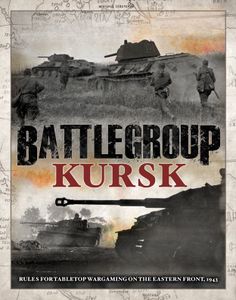
Review of Battlegroup Kursk rules


In an earlier blog post about whether to get the new Bolt Action WW2 rules, I mentioned some other rules I had tried, and I considered revisiting Chain of Command (CoC). When I went to my rules shelf I noticed a rules bundle I had purchased at a B&B stall (I can’t remember where or when) and I had never untied, or looked at them, once I had got home. These were the hardback books Battlegroup Kursk (BGK), the Battlegroup Overlord supplement and an A5 softback version of the rules (all together costing me only £20 compared to a RRP of £70!). So, rather than play CoC again, I decided to give BGK a go. I have managed to play a few solo games all using Eastern front 20mm forces on a 6’x4’ table and 250 points (i.e. Squad level game).

The ‘Orders’ section of rules is straightforward; all the standard, obvious options are available and include reactive orders, allowing covering fire etc. The reactive movement (rather than the reactive fire) order is a bit strange, and I never used this in my games. The turn order is IGO-UGO and number of orders available to a player results from a single D6 roll plus the number of officers in the force, which can give widely fluctuating results. Larger games use multiple D6’s and give a more standard range of results. Some things were not clear: German infantry sections have 2 teams (rifle and LMG) and I was not sure whether this needed a single order (in which case, why have separate teams listed), or individual orders (in which case, the German player will struggle with the number of orders required)? Reading the Overlord supplement, I found a rule for separating Bren teams from their sections in the British listing, and I decided to use this for the German sections/teams in my games (I’m still not sure if this is correct). I also was not clear about man-portable heavy weapon teams (HMG, mortars etc.), because there did not appear a requirement to set them up; could they simply move and fire like normal infantry teams, or should they be considered as Very Light weapons teams and need an ‘unlimber’ phase before firing?

The ‘Movement’ section is again nice and simple, but maybe too simple? There is no deduction for infantry movement in rough/difficult terrain. OK I can live with this, but I instinctively feel that marshes, woods, hedgerows etc. would have an impact. What do you class man-portable heavy weapons as? I think lugging a heavy base-plate for a mortar would significantly slow you down. Tracked armoured vehicles can weave about with no apparent deduction; I had a T-34 move down a road in a village, take a sharp 90 degree turn, then make another 90 degree turn around the side of a house, and then another sharp turn to face the enemy, all with no speed reduction.

The ‘Direct Fire’ mechanisms are again streamlined, all basically following the same procedure: observation, hit, save/penetration. I quite liked the fact you may not necessarily see the target and therefore not fire; and also liked the differentiation between firing for effect and pinning/covering fire. Pinning is pretty much as valuable as killing targets, due to morale effects discussed later. I had no major quibbles about weapon ratings etc., except possibly the German MG34/42 is over-rated? A rule that I used frequently was when a squad was trying to close assault; if multiple casualties are inflicted, you can instead take a single loss, retreat back to cover and become pinned. The vehicle listing seems to indicate that players should record the number of rounds fired. Really? I ignored this in my games – Life is too short for such nonsense!

The ‘Indirect Fire’ section follows a similar process but does raise some issues. I liked the ‘Communications’ aspect for calling higher command support, but this does burn a players order count. The accuracy dice roll again seems a bit random, and you can cancel the fire order if the ranging round falls short. There is no ability to ‘walk-in’ the artillery in subsequent turns, and the danger zone is standardised and not related to the calibre and number of weapons firing. The biggest omission is the lack of smoke rules, which is very strange indeed!

The ‘Morale’ section can be split into two. At a unit level, a casualty or non-penetrating hit results in a simple D6 dice roll, Veteran/Elite troops can re-roll, but this seemed to me to be too simplistic. Troops that are already ‘Pinned’ and fail, rout off. If a player rolls a straight 6, then the unit has a chance to take an immediate counter-action. At the battlegroup level, each force has a numeric strength and morale effects result in the random drawing of ‘Chits’ that reduce this value. I really like the uncertainty this mechanism introduces, particularly because it can result in occasional side effects e.g. mine strike, air strike etc. Reduction of battlegroup morale to zero results in defeat. Strangely, rallying unit/units from Pinning requires the drawing of a chit to rally D6 units. It would seem that waiting for the number of Pinned units to rise before rallying would be sensible, but this is often not practical. Units that tend to be pinned are those at the focal point of your plans, so you cannot wait to get them active again, and therefore you have to rally even if only a single unit needs such treatment. I have found games to be frequently lost simply by the effects of pinning opposing units, and obliging an opponent to rally. Maybe my game play and/or tactics are at fault, and I would be interested to hear what other gamers think?

Before I discuss the non-rules aspects of the BGK publications, I will comment about the type of game they give. I like the speed of play, the mechanisms are clean and simple, and the use of chits to determine victory is good. The order system is fine but rather random when using ‘Squad’ level games. Combat is clear and does not require constant double checking in the main rules. The main weakness lie in the unit morale system (too simple) and rallying. The lack of smoke rules is bizarre! Overall, I cannot see BGK becoming my go-to WW2 rules. I will stick to CoC, which I think gives a better game, and I also still intend to try the new version of Bolt Action.
The A5 paperback rules are excellent (only £10). Regarding the hardback publications (£25-30 each), I would be very disappointed if I had purchased them at the normal price. Why do authors think they have to provide pages and pages of potted history in such publications? If a reader wants historical background then there are a wealth of sources, online or published, that can be easily accessed and  provides for all needs, in greater detail and accuracy than provided in these rule publications. They then add in a simple painting guide as well. Do they think a person buys BGK as their sole source on a period, especially ones as well documented as Kursk or Overlord? I’m sorry to say that I find this ‘fluff’ annoying, especially because it’s inclusion bulks up the book and results in increased cost for little benefit. The majority of both hardback books centre on army lists. I generally enjoy a good army list. I find they inspire me to investigate/get new units, and I like the way they constrain players to field forces that feature the common elements used historically. There are poor army lists out there, which some players can exploit to generate ‘super’ armies but, on the whole, I like an army list. The lists provided in Battle Group Kursk/Overlord are bad! Not because they are inaccurate, unhistorical, or unbalanced, but because they are extremely repetitious and tedious. For example BGK has only 4 lists: German Panzer & Infantry, Russian Tank & Infantry. This is fine, but each list repeats the information in the previous list. They share the same elements on the whole; a German infantry platoon/squad is the same in both German listings, as are the tank units, support units, recce units etc. etc. I’m sure there must be a few variations between lists, but 90%+ of each list is repeated information. The format of the army lists is again poor; each list takes a dozen sides of A4, when a better format could easily reduce this to a couple of pages! With a bit of thought and editing the authors could reduce the entire rules to the A5 rules booklet and separate, smaller, slimmer, A5 army listings. Even better would be to publish the army lists online as free pdf files! Such a decision would make BGK an attractive purchase, but in the present form I would not recommend these rules to another gamer! What is even more astounding is the authors are producing further campaign dedicated hardback books! Rather than finish on a negative note, I do like the inclusion of minor, often neglected, support elements e.g. combat medics, signallers, repair mechanics etc.

Tuesday, 11 October 2016

AAR; ACW (Longstreet rules) 9 Oct 2016


This was the 7th battle (early 1864) of a 9 battle mini-campaign using Longstreet rules by Sam Mustafa (Honour Publishing). My Union force played against the Rebels commanded by Ian. I was ahead in the campaign by 5 victories to 1 defeat (24:21 EP), and in each battle the defending force had won. The composition of my force can be viewed in my previous blog post (November 2015).

 We randomly selected the ‘Meeting Engagement’ scenario and there was minimal additional terrain added. This scenario is interesting because there are no objective markers and there is no advantage to being either the attacker or defender. So this should be an equally matched contest. The thing we had not taken in to account was the club AGM which was also scheduled for the afternoon. Like all club AGM’s I have ever attended, this went on longer than expected, and so the time available for our game was severely curtailed. We decided to carry on in the couple of hours left to us.

Both armies entered from diagonally opposite corners, so the first turns involved rapid movement in columns, followed by deployment into battle lines. All my games against Ian seem to involve great swings in lucky/unlucky dice rolling. The ‘dice gods’ seem to be toying with us. In this game whenever I had a situation that I was optimistic about, I rolled badly. Whereas when I was in trouble and pessimistic, I rolled exceptionally well! My vastly superior artillery just could not destroy an opposing Rebel battery despite numerous opportunities to roll 4+. A successful charge by a fresh Union infantry unit against another exposed, isolated rebel battery was repelled by melee combat! In contrast, I shot at a 5 strong Rebel unit with 10 dice needing 4+ to hit, scored 10 hits, most of which converted in to kills, wiping it out in a single turn! Ian pressed a well co-ordinated attack against my left flank and I thought I was in deep trouble, but here luck was on my side: firstly, I played the ‘They couldn’t hit a...’ interrupt card which removed all of Ian’s careful hoarded 6 cards just prior to his key attack turn; then in my turn, I used a recently obtained ‘Retrograde’ card to move my endangered units out of the path of attack. Without my fortunate card play, I’m certain the game would have been lost! On my right flank the action did not develop as quickly, but I was confident that my 7 base coloured regiment and battery of 3 Napoleon guns would hold their own.


Unfortunately time was not on our side and the game ended early in a draw. Both sides had lost 10-15 bases each (the victory target was 23). I felt I had played poorly (I only scanned the rules before the game and was very rusty) and that Ian had the upper hand, so a draw was a good result in this game. Due to the constraints of time, I only took 1 photo and this was as we were doing the (hurried) campaign phase at the end (also the battery was out of juice, and the photo was taken accidentally!). Neither of our commanders was promoted (Ian need not have rolled because he has already reached the maximum 4 Eagle rank). My army did suffer in the campaign attrition phase, with my coloured regiment losing 3 bases! My campaign cards yielded an improvement to scouting in the next game (as if I needed such a bonus), a couple of new units (including another large coloured regiment), plus repeaters for my Maine regiment. My Union force available for battle number #8 will be:

Commander
Personality
Rank
EP’s
“Art” Rooney
Indian Wars Veteran
(Scout: 2D6 & keep higher)
3 Eagles (2/63)
26
Unit
Type
Elan
Exp.
Strength
Notes
9th Pa Artillery
ART
-
-
3
3x Napoleon
37th (Prov) Pa Infantry
INF
Season
Veteran
7
 
13th\14th Pa (Prov) Inf.
INF
Season
Veteran
4
Sharpshooters (5,6 Skirm Fire)
16th\45th Ohio (Prov) Inf.
INF
Caut.
Veteran
4
Sharpshooters (5,6 Skirm Fire)
26th NJ Artillery
ART
-
-
3
3x Lt Rifle
29th NJ Artillery
ART
-
-
3
2x Lt Rifle, 1x Hvy Rifle
7th US (Coloured) Inf.
INF
Eager
Recruit
4
 
8th Maine
INF
Season
Veteran
5
Repeaters
10th Vermont NEW
INF
Season
Veteran
6
 
11th US (Col.) Inf. NEW
INF
Eager
Recruit
10


49 bases
 
Broken Code: add +2 to scouting score in next game.
Notes: The units are listed in order of campaign appearance. The Pa units are from my original force. The 37th Pa, 12th NH and 88th NJ were so battered that they were combined in to the ‘new’ 37th (Prov) Pa regiment.

Saturday, 1 October 2016

Bolt Action 2; Yes or No?


When Graham recently visited for a gaming weekend, he mentioned the only non-Flames of War game he had played in the last few months was Bolt Action, and he indicated that he thought they gave a reasonable game. I have only played a single game of Bolt Action and then only half-heartedly; a small club game that I was invited to join when I had no game of my own planned. I must admit that I did not fully participate or concentrate, and spent most of my time chatting to other gamers about this and that. I recall that I was initially confused about the command dice, thinking that you had to roll them to ascertain you order type (clearly wrong), and my fellow players did all the calculations, simply telling me how many dice to roll and what I required. I remember we were British infantry, with some armour support, and we were hammered by the Germans who were armed with assault rifles and plenty of MG42’s. Snipers were also a pain, picking off targets at will, although officers/leaders did not seem to have any beneficial effects. My partner muttered about the Germans having a ‘gamey’ list choice, but I was just happy rolling some dice and enjoying myself, rather than worrying about winning or losing. Soon after Graham departed, I noticed reports that Bolt Action version 2 was about to be released, and my interest was piqued. I have since checked them out online and read a few battle reports.

WW2 has never been a major gaming interest for me, but I have dabbled and own a reasonable number of 20mm troops for the main European participants, and these have sat in their box files for many years. I have tried numerous rules; the simplistic (Rapid Fire), the flashy (Battlefront WW2), the innovative (Crossfire) and the popular (FoW), none of which has grabbed my attention. More recently I have played Chain of Command which I did enjoy but surprisingly, after the initial burst of enthusiasm, they have remained largely on my rules shelf.

So, the question is: Should I invest in Bolt Action 2? Are they any good? Or, am I not cut out for WW2 games? I ‘think’ I want a fast action set of rules focussed on Platoon/Company level infantry action, which can accommodate some armour (which is not over-powering), and which does provide a good degree of period ‘feel’. What I mean by ‘feel’ is some variation in the tactical approach used by the different nations, and forces that don’t just take part in a dice-fest, but instead use covering fire etc. to set up attacks, and do not fight on to the last man standing.

Any thoughts, opinions or advice out there? I have a month or so before they are released, and maybe I will dust off Chain of Command and see if I can wet my WW2 appetite again.