Monday, 6 June 2016

UKGE 2016


Elaine and I attended our second UKGE event at Birmingham NEC, and this time were accompanied by Val and Chris. Whereas last year the event was held in a warren of rooms within the Hilton hotel, this time the organisers held the main event in Hall 1 of the NEC complex. Generally I think this was a good decision; all the traders and game designers were together, there was more room for the punters, finding stands was clearer and admission easier. On the negative side; the venue is ‘soulless’ (a bit like the Salute wargame show at Excel), and popping back to your hotel room with purchases is not viable. Like last year, visiting on the Friday is great because the crowds are not overwhelming and sitting down to play games is a smooth process. On Saturday the crowds come in and moving around is slow, arduous and getting shoved about is to be expected. I was surprised the organisers did not utilise the full floor space of the hall and there was a large open, unused area near the Bring & Buy. I think they could have spread the trade stands out, allowing better movement (especially on the Saturday), or alternatively significantly increased the Bring & Buy section which always suffers from cramped access. In the evening the gaming activity returns to the Hilton hotel complex, with a number of large rooms set up for open gaming and competitions, but no trade stands. This worked well and I think the organisers need to increase the number of gaming tables available further. I like the long bench type of set up, rather than standard tables, because it encourages different gamers to interact and not just focus on the game they are playing.
We spent all Friday afternoon wandering around looking at various trade stands, and interspersed this with sit downs to play a game or two hired from Thirsty Meeples (who again performed magnificently). Elaine wanted to go to the Ragnar Brothers stand to purchase a copy of the ‘Barking Up the Wrong Tree’ game that we played as a kickstarter last year. Whilst there she also purchased ‘Blooming Gardens’, a horticultural themed game which we played for the first time latter in the day. The aim of the game is to create a garden of various flowers which bloomed over successive months with as many ‘valuable’ species as possible. The theme was great and the cards beautiful. The game played quickly (~30 minutes) and was fun. The strategic aspect of choosing the ‘right’ species was good and playing slugs on opponents flower beds worked. I can see us using this game as a filler game in the future.

As Val, Chris and myself are scientists, we were naturally drawn to trying a kickstarter called ‘Lab Wars’. The theme obviously worked for us and all the equipment required to establish a lab was familiar. The interactions between the lab operatives was also humorous with the post-doc hindering the PI, or the grad student causing mayhem etc. The mechanics of the game felt clunky, the iconography was not clear, and I certainly felt puzzled about what I was actually doing even though the goals (published papers, books and Noble prize) were clear. I think this game requires a lot more work and thought before it is published.

Whilst Val and Chris tried a game involving hamburger production, Elaine and I had a quick game of giant size, wooden ‘Quatro’. This is a simple 4-in-a-row style game with multiple winning type of pieces (light/dark; small/large; hollow/solid; round/square), and the added twist in that your opponent picks the piece that you have to place. We both enjoyed the game and latter bought a travel set from the Bring & Buy stall.

In the evening the four of us sat down to play a couple of games hired from Thirsty Meeples. We started with ‘Sheriff of Nottingham’ which is essentially a bluffing game. Players take turns as the  ‘Sheriff’ whilst the others attempt to smuggle valuable contraband goods into the market. Bribes and counter-offers can be freely made, and a ‘poker-face’ is a definite advantage. If the ‘Sheriff’ successfully intercepts contraband goods then he makes money, but if he incorrectly challenges and fails then he loses money. After a couple of rounds the players tally up the goods on their market stall; those with the most for each food category gain bonus points (money), and contraband goods score most money. Surprisingly, I won! Overall, an enjoyable game. It was unusual because I cannot think of any other strong bluffing game in any of our games collections. I suspect that this might be a game my niece, Erin, would enjoy and be good at.

Next we played ‘Chinatown’ (which I think is now out of print). Your role is that of a merchant trying to get adjacent plots within Chinatown and establish businesses of the required size on those plots. Players have a free hand to make deals with others over plots, business chits, money etc., and haggling is fierce! The game was great fun (in fact, I believe it was the best we played during our two days at the show) and Elaine was the eventual winner – a shrewd negotiator! I would love to buy a copy (none to be found on the Bring & Buy stall). I suspect the theme of the game has been taken up and developed by the more recently released ‘Lords of Vegas’ game. I plan to investigate further and may purchase a copy in the future if this is the case.

On the Saturday we re-visited the main trade hall and the crowds were now beginning to come in which made browsing difficult. Therefore we decided to just to sit and play more games. We trialled a game called ‘Carrotia’ with beefed-up rabbits attempting to steal carrots from maze whilst being chased by birds. This game, although fast, did not appeal to any of us. The mechanics were weak, the theme weird, and the art and production values poor.
We next played ‘Machi Koro’; where players are trying to build a town using cards, which they buy and then use dice to activate those cards. Some cards gain you bonuses on other player turns. The player to complete three landmark buildings, wins. This was a surprisingly good game! We all picked the rules up quickly and appreciated what we were doing. Keeping track of your cards was the key, especially as some could be devastating – I particularly liked the tax office, which worked well for me. We all approached the winning line together and Val pipped me to the post for victory. I think this game is on my shopping list for the future. Finally, we ended the show by playing ‘Black Gold’, themed around oil prospecting in the USA. The game took a while to set up and to understand the rules. By the second or third turn we started to understand what we were doing, but time was passing so we abandoned the game halfway through. This is not a reflection of the game itself but rather the fact we were about done with the show.

To conclude, UKGE2016 was an excellent event. All the traders were keen to demonstrate their wares and games. Other gamers were friendly and communicative, happily giving their comments and views concerning the games they were playing. Elaine and I will certainly attend next year.

Finally, on the Sunday Elaine and I played one of the games purchased at the Bring & Buy stand i.e.  ‘Carcassonne, the Castle’ – a specifically designed, stand alone, two player version of Carcassonne.
In many respects the meeples in the game act similar to the normal base game, but the tiles are placed within a constraining castle wall. Also on the castle wall is the scoring track and a number of bonus chits which players can collect and which allow different end-game scoring bonuses. There is more flexibility when placing tiles and the only restrictions are the paths which cannot be blocked or interrupted. From previous posts you will know that I love Carcassonne as a base game and enjoy most of the expansions, but it really is a multi-player game. ‘The Castle’ is brilliant as a two-player game and some of the design features work better than in the original e.g. the ‘farmer’ meeple and the market stalls. I also really like the bonus chits which force the players to consider their scoring options: do you want to score high but miss the chit, or take a low score and collect the chit? So, this is a game I’m really pleased to have bought and I totally recommend it to anyone who likes tile laying games.

Tuesday, 17 May 2016

Boardgame session; 12May2016


Just a brief report. Elaine and I spent a week walking in the Lake District; lovely sunny weather and it was hot (!). No thermals or wet-weather gear required, which is a first in almost 30 years of visiting the area. In the early evening we settled down in the hotel garden and played a couple of ‘travel’ games we had taken with us. We like to pack some light games when travelling because there is always an awkward gap in the day between returning from a hike, or other activity, and sitting down to dinner. Sitting around a pool is another awkward time, especially when you have finished your book and are at a bit of a loss. We started with ‘Hive’ with the ladybird expansion. This is a game we both love; it requires considerable strategic thought but is reasonably fast to play. I’m pleased to report that I won 3 games in a row. We then moved on to ‘Cribbage’ complete with a small, folding scoring board. I won 4 games in a row, but the last game was lucky because Elaine was only 1 peg away from victory when I came back and won with a high scoring crib. Elaine was sure I must have been cheating because she hammered me the last time we played. Even though the results were one-sided, the games were enjoyable and nicely filled in time. Our next gaming experience will be at the UK Games Expo in a couple of weeks.

Tuesday, 10 May 2016

First impressions of Sharp Practice version 2


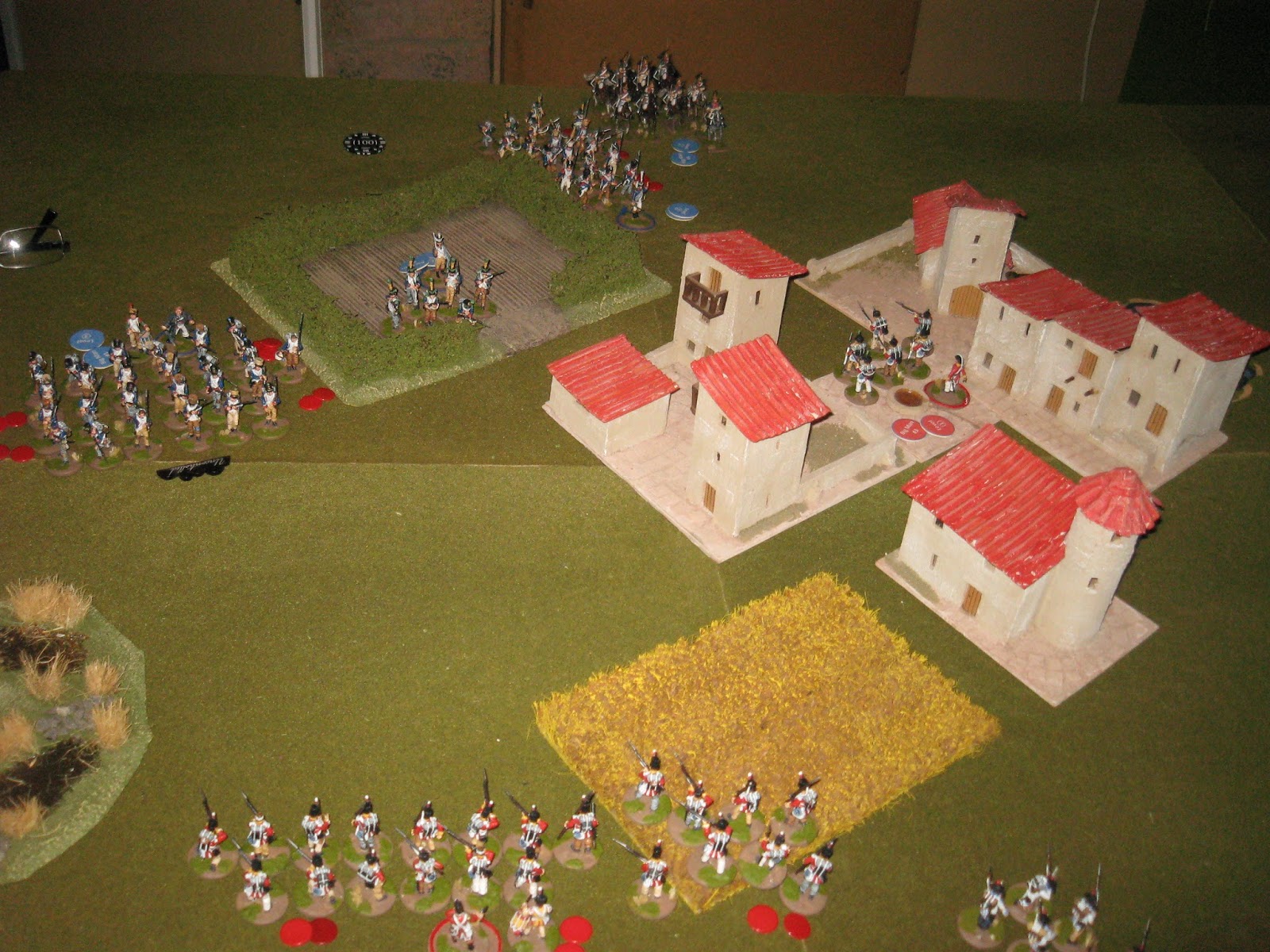
This post really is only my first impressions of Sharp Practice version 2 rules by Richard Clarke (TooFatLardies, 2016) and cannot be taken as my definitive opinion. I have read through the rules a couple of times and played a single solo game. I have previously played the first version of the rules many times and really like them. The solo game was set in the Peninsular in 1813 between a British regular force with some Spanish allies and a French regular force plus some grenadiers and dragoons (60 points aside). The game was an encounter with the aim of securing the centrally placed village. Both deployment points were opposite each other on the same flank of the table.


The British got off to a flying start deploying a solid firing line of regulars facing the French under the level III senior officer, whilst the light infantry skirmishers moved into the village and a second formation of regulars moved towards the opposite flank. The Spanish militia remained in reserve and moved to support the skirmishers. The French main formation moved against the British firing line in column of attack with supporting skirmishers on the flank (not out front), whilst a second column headed towards the village. The French dragoons failed to deploy at the start. The British firing line opened up on the French column using ‘controlled’ volleys augmented by ‘crushing volley’ (causing double shock) when the required 2 command tokens were available. This pretty much stopped the French in their tracks and they were reduced to attempting to return fire as best they could because the accumulated shock severely reduced any forward movement they may have attempted. The French remained too far away to successfully utilise the ‘Pas de Charge’ characteristic. Eventually after a few turns the French were ground down, the formation broke apart and constituent groups routed.


In the village the British skirmishers looked comfortable but the French dragoons eventually deployed and immediately charged at the gallop. The British skirmishers were thrown back (their officer had a lucky escape and scrambled back with light wounds), but the dragoons charged again and wiped them out! At this point the group of Spanish militia opened fire and lucky dice resulted in the repulse of the dragoons. At this point the game was over due to the deductions from the French force morale, and a clear British victory was achieved. Both sides had some uncommitted formations, the second formation of British regulars secured the far flank unopposed, whilst the advance of the second French column (with the grenadiers) was blocked by the attack of the dragoons down the main street of the village.

So what did I think of this second version of Sharp Practice? The presentation, lay-out and writing are all very much improved. The rules look great and read well, with clear, useful, illustrated examples of play. The army lists and scenarios at the back are also a great addition. I feel these rules are significantly different and are an amalgam of Sharp Practice version 1 and Chain of Command. I like the use of deployment points, and I think the purchase of a secondary deployment point may be important in future games. I like the defined unit size because I always dithered about what was the optimal unit size under version 1. This version of the rules certainly facilitates the use of formations, particularly for regular groups, and this was an aspect of the earlier version I always struggled with. The replacement of ‘Grasp the Nettle’ for Command chits is excellent and forces the player to consider whether to horde or play them. I suspect I will turn out to be a ‘hoarder’ because you can always use them once the Tiffin chit appears. The firing rules seem simpler to me, and controlled, crushing volleys are devastating! I think I like the uncontrolled volley rule which can result in your formation blasting away rather than obeying your commands. I initially mis-read the ‘Chapter Ends’ (p31) ruling and thought this applied to each draw of the Tiffin chit, which would have been stupid, but this shows the importance of reading the rules carefully! The ‘Random Events’ rules were much easier to apply than those found in version 1, which I had given up on using because they were too easy to overlook. It is certainly easier to get into fisticuffs, at least if you have little or no shock, but I struggle with the rule that deducts an inch of movement for each point of shock. I find this slows a group or formation to the point of stagnation very easily. I suspect I will use a house rule that deductions are only made for each 2 shock points (this would bring the rule into line with the deductions for firing and fisticuffs). One issue that arose in my game was when the French dragoons galloped into contact with the British skirmishers; there did not appear to be any combat advantage to charging at the gallop and, as far as I could see, movement stopped at contact. I would have thought that irrespective of the fisticuffs outcome, the galloping dragoons would have ‘burst’ through skirmishers continuing their move due to momentum. In the second charge action (which wiped out the British) they only moved 6” of the possible 21” the dice allowed them to move. If they had continued they would have hit the poor Spanish militia behind, but as the rules played out they had stopped and presented a prime target for the Spanish muskets! I would be interested in the thoughts of other gamers.

The Force Morale rules appear to be straight from Chain of Command and provide a clear end-point to games. I think the Big Man characterisation (section 9) can add colour to scenarios but I’m not sure knowing that Big Man #3 is ugly as sin and not likely to pull is going to be a major part of my pre-game preparations. Too much bother and adds a level of detail I’m not seeking. The details I am likely to pursue are the addition of medics, civilians and various carts to my forces, and now I have a use for those drummers and standard bearers I already possess.

To conclude, from the basis of a single solo game, I generally like version 2 of Sharp Practice. I prefer playing using chits rather than playing cards; I hate shuffling and the cards soon get ‘dog-eared’. The rules are an improvement compared to the first version and they represent a significant change rather than a modest development or re-write. I do have a few problems (as discuss above) but nowhere near the number the first version posed. I can see me using the rules a lot and enjoying many happy games, particularly in the Peninsular setting. I think they will not replace Muskets and Tomahawks for FIW or AWI games, but I will try them out in these different settings. The rules may inspire me to purchase some Indian Mutiny figures (caution needed)!

Off the Painting Table (May 2016)


I have completed my FPW 10mm Prussians in record time! I’m only showing a few in the photo below, but in total I have completed 20 bases of infantry, 6 bases of jagers, 5 bases of dragoons and 6 bases of artillery. I plan on painting my 1859/66 Austrians next but I need to by a few more packs first. The army pack I bought did not have any command figures and I want a few rockets as well. I cannot face base texturing at the moment, so this will wait until I have finished painting all the figures for this period.


As a sideline I painted up the free Salute 2016 steampunk figure. I copied the figure shown in the show guide, and I think it looks excellent. I have no idea what I could possibly use this figure for!.